
The Empty Steppe: Part V
Nick Griffin casts about, an obedient priest builds a theme park in Crimea, and our story comes to an end

This is Part III of a five-part series, about contemporary authoritarianism, the online far-right, and dreams of a place called Novorossiya. It explores how all these ideas converge, on the steppe of southeastern Ukraine. Part I is here; Part II is here; Part III is here; Part IV is here. If you enjoy or find my writing valuable in any way, please do consider subscribing (it’s free) or sharing this essay with anyone apart from the Russian embassy. They’re not worth your time.
Nick Griffin, one-time leading fascist of the United Kingdom, has finished watching his video. John J. Mearsheimer’s latest commentary on the Ukraine war confirms Nick’s worst fears: the mainstream media has been lying, getting up to its nefarious Zionist tricks, pretending the Ukrainian army still stands a chance, pretending there is such thing as Ukraine to defend. Their defeat is assured, and the sooner their obstinate president faces up to reality, the better. Never mind that the US ‘peace plan’ leaked in November 2025 was an automated translation from Russian: might is right, and the Russians deserve even the parts of the Donbas they haven’t already destroyed.
Unlike Donetsk and Luhansk, Nick’s home territory of Suffolk never became an industrial heartland. But like these Donbas oblasts, Suffolk is a flat place at a nation’s easternmost extremity. A beautiful, gently undulating landscape of ancient woods and heathland, muddy estuaries thronging with migrating birds, brooding under huge skies. A kind of rural paradise, except it didn’t seem so for Nick’s old man. Edgar Griffin joined the National Front in the 1970s and took his son along to meetings. Britain was facing an existential threat, he thought: immigrants with black or brown skin, pouring across the channel not only to work as nurses and in factories, but also to swarm the indigenous British with their alien ways; to empty the country of its culture by filling the land. This intermixing had started recently and suddenly, Nick decided: until it made the ruinous decision to fight Hitler’s Third Reich, Britain had been a monoculture, fortress homeland for a single unadulterated white race. Britishness wasn’t a matter of historical process, that slow dialectical movement from something top-down or acquired to something organic and deeply felt. British was not something an outsider could become.
Shifting in his office chair, Nick lets out a belch. Pitch dark now, beyond the window; inside, screenlight spills weakly over the desk. Nick’s comment under Mearsheimer’s video, gesturing at a neat and daring theory – maybe, just maybe, the ‘secret agenda’ behind globalist support of Ukraine is to empty the country, thus continuing the work of Great Replacement – has garnered a handful of likes. Over the next few weeks, it even attracts a couple of replies from strangers, at least one of whom is probably not a bot. But from the professor, nothing.
Nick could do with a holiday. It’s hard work, making your living online. The internet provided Nick a lifeline in the low years after his deposition in 2014. He could keep in touch with the old guard, and mug up on the latest neat conspiracy theories. But these days the market is saturated; the alt-right space has been monopolised by a few central figures, just as the internet itself has been seized and apportioned by a handful of companies. Nick can speak his mind, even address himself directly to Mearsheimer, but he can’t get a reply; the professor is too busy appearing on other podcasts, to put the Kremlin’s case. It isn’t fair!
The internet was supposed to be a forum, a space of true democracy that belonged to everyone, a digital commons. But if the internet of 2026 resembles a public park, then the park has been taken over by a festival, a great spectacle of acts and amusements. Anyone can buy a ticket, and anyone in the audience can compare notes, or tell each other to go fuck themselves. The one thing you can’t do – just like before – is gain access to the performers. And beneath your feet, the flowerbeds have been trampled, the grass cut to stubble. The empty steppe isn’t in southern Ukraine, it’s online. From the wild west to which it used to be compared, the prairie of the contemporary internet has retained only the lawlessness and lack of accountability. The radical, anarchic utopianism has disappeared, captured by the co-opting forces of digital enclosure.
Nick has switched tabs. He’s checking his account on a discreet social media platform that supports genuine, robust debate. An advert flashes up and in the corner of his eye Nick sees a flash of white stone. He looks closer: a terracotta-topped classical palace, gleaming under electric blue sky. It’s an advert for a theme park – but not a western-style theme park, with vegan toffee apples and LGBT rollercoasters. This one’s serious and historical. It’s called New Chersonesus, built a stone’s throw from the Original Vladimir’s baptism site in southwestern Crimea, and a quick look promises an array of impressive features: a brand new Basilica with retractable roof; a craft market where teenage girls in short-skirted versions of Byzantine traditional dress demonstrate how to mint coins; an amphitheatre whose big empty stage just cries out for patriotic historical re-enactments; and a slick, tablet-heavy exhibition on the settlement of Novorossiya. New Chersonesus is the culmination of ten years’ work by Tikhon Shevkunov, bishop of Simferopol and Crimea. Widely known as Putin’s confessor, Tikhon has shown the president around his theme park, and anxiously awaits his return now that the teenage girls are up and running.
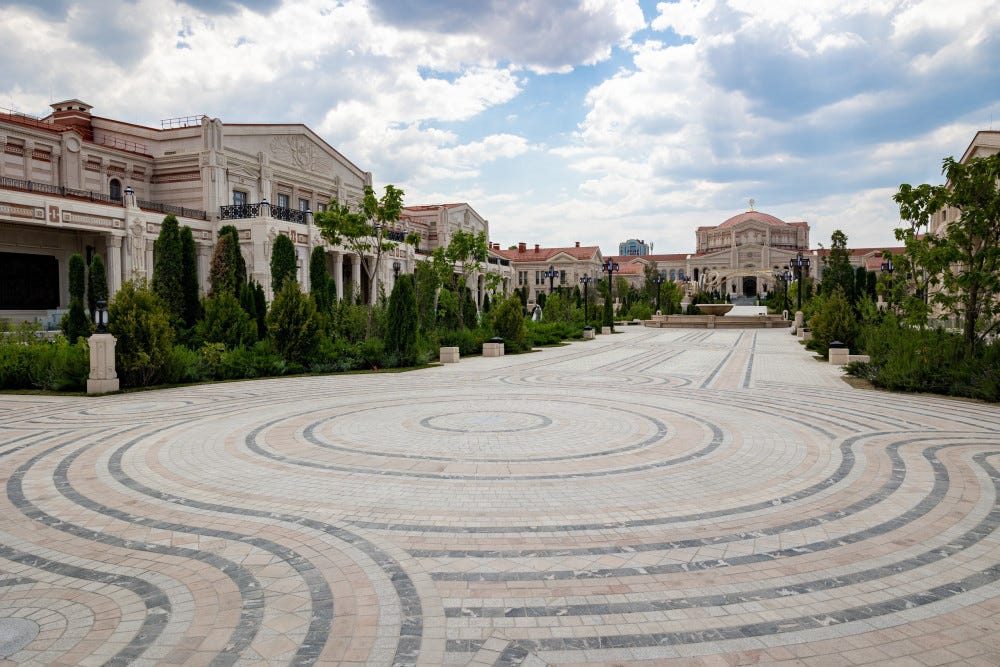
Nick is already researching flights. A weekend at New Chersonesus sounds just the ticket. Only the small matter of finding his way into Russian-occupied territory without being declared a security risk. But he’s definitely going. This theme park might prove the epicentre of white Christian civilisation’s rebirth. If it does, Nick is not going to pass up the chance to pose, decked out in bumbag and Novorossiya baseball cap, for a selfie by the craft market.
Spare a thought for Konstantin Malofeev. Tikhon Shevkunov has pissed on his parade: the idea for a history-resurrecting, Russia-glorifying theme park in Crimea was originally his. Malofeev wanted to build a dream city called Tsargrad, named after the monarchist TV network he founded in 2015 (Alexander Dugin was chief editor), and ultimately the Russian name for Constantinople. But his influence with the Kremlin waned, and his influence in Donbas separatism shrank too, after Vladislav Surkov took over the Novorossiyan project in 2014. Malofeev’s Safe Internet League never really cut through, either. It turned out that the Kremlin cared more about its ability to control the flow of information than about ‘traditional morality’, and by the time Malofeev started advocating for a cleansing of the internet the Kremlin already enjoyed an information monopoly, effectively controlling the narrative with its firm grip on TV, piping a mixture of Soviet nostalgia and anti-Europe hysteria, whipping up fear and at the same time seeding a demobilizing bewilderment in the living rooms of Donetsk and Luhansk.
In the west, meanwhile, the Kremlin found that a chaotic, unregulated internet suited them just fine. Pouring propaganda and disinformation into western platforms, flooding the zone with shit, they waited for the algorithm to work its magic. Westerners doing their own research met with a personalised, tailor-made reality of what was happening over there in Ukraine. Reality fractured into a thousand pieces and became an assemblage of dreams, an ontological Novorossiya.
Konstantin never managed to create his Orthodox colony on the shores of the Black Sea, or achieve his dream of restoring the monarchy to the Russian empire. Like Nick Griffin, his thunder stolen by Nigel Farage, whose political organisation currently leads the UK’s polls, he was in the right place at the wrong time.
But Malofeev does have a route back in. When the International Criminal Court issued its first round of arrest warrants following the Ukraine invasion, in March 2023, two individuals were indicted. One was Putin. The other was Maria Lvova-Belova, commissioner for children’s rights. Lvova-Belova was accused of organising the kidnapping of hundreds of Ukrainian children from orphanages and care homes, transporting them to the motherland to be brought up as Russians by Russian parents, all traces of their Ukrainian roots wiped clean, erased and expunged. It’s a direct contravention of the Geneva Convention, a serious war crime. It also exactly mirrors what the Nazis did in the parts of eastern Europe they occupied, including western Ukraine: kidnapping Aryan-looking children and sending them to childless German families. Lvova-Belova would vociferously deny the charge: she’s not kidnapping Ukrainian children, she’s rescuing Russians from the cult of European decadence. She’s a decent person, she’d protest, a woman of strong family values. She’s recently married, to Konstantin Malofeev.
In the Kremlin’s paranoid framing, Ukraine’s government has been taken over by fascist psychopaths. An older but recurrent and unextinguished Russian neocolonial fantasy imagines the Ukrainian steppe as essentially empty, devoid of civilisation and overrun by savage barbarians. Both fantasies, in a grim and terrible irony, turn out to be direct projections. The Russian state and its officers are the fascists. They have emptied the steppe; they are the barbarians.
Ukrainian civilians and soldiers are enduring a freezing winter with little power after the latest round of Russian bombardment. If you’re in London, check out the Ukrainian Institute for various cultural and educational events; if you’re elsewhere their website has lots of information on how you can support the Ukrainian cause, including help for refugees.