
The Empty Steppe: Part II
An American professor goes viral; in Vienna, an Orthodox oligarch summons his order

This is the second of a five-part series, about contemporary authoritarianism, the online far-right, and dreams of a place called Novorossiya. It explores how all these ideas converge, on the steppe of southeastern Ukraine. Part I can be found here.
It’s June 2015: eight months since Nick Griffin lost control of his beloved BNP; over a year since war broke out in eastern Ukraine in the wake of the Maidan revolution the previous spring. At the University of Chicago, a professor of political science is getting ready to deliver a lecture. John J. Mearsheimer wears a blazer and a smartly knotted crimson tie. He’s speaking to a packed lecture hall, but hopes his words will carry beyond its walls – the university has decided to film the lecture, and there’s talk of sticking it on YouTube.
Mearsheimer has been analysing Ukraine for years. It’s proved fertile ground for his signature thesis. According to ‘offensive realism’ the world is still dominated by great powers; although the world itself is a free-for-all, great powers always act rationally to ensure their own survival, even if this involves pre-emptive aggression. A classic survival strategy is to create a sphere of influence – and this, Mearsheimer argues, is what Russia has been trying to do in Ukraine since the dissolution of the USSR. But in eastern Europe spheres of influence overlap: the west is trying to incorporate those countries too, by bringing them into confederations and treaty alliances like the EU and NATO. In this light, John thinks the Maidan Revolution – the uprising against President Yanukovych’s last-minute backslide on an EU trade agreement in favour of ties with Russia – was unfortunate. If a sizeable constituency of Ukrainians were protesting in favour of being European, it was our fault in the west for encouraging them. What ‘we’ should have promoted instead was Ukrainian neutrality – and at this point of the lecture, John gets halfway through saying that ‘we’ should ‘neutralize Ukraine’, but then he stops himself and says instead ‘work to create a neutral Ukraine’. Whoops. Silly me, slip of the tongue.
Ten years later, Mearsheimer’s lecture has thirty million views. More than the population of Australia. It helped to launch Mearsheimer to internet prominence as the voice of sceptical so-called realism on Ukraine. Mearsheimer professes to dislike Putin, but that hasn’t stopped Russian diplomats using his lecture to support their case. Right up until the 2022 invasion, John dismissed fears of large-scale war as hysterical western paranoia. (Again, whoops.) But he continues to grind away on the online circuit, appearing on countless podcasts and YouTube channels – neatly dressed, as always, in blazer and tie – to make his case. And so it was, in late 2025, that Nick Griffin watched John Mearsheimer speak on the possible ends of the Ukraine war.
It’s not about Nazism, Mearsheimer explains to his host, a retired American Lieutenant Colonel. That’s just what Putin says to drum up support. Putin’s far too sensible to honestly believe that Ukraine’s government are fascists. It’s not about dreams of restoring imperial glory, or addressing the nationalist grievances that arose in the terrible 1990s in post-Soviet Russia. It’s always been a strategic conflict between rational actors about spheres of influence, a quarrel over the extent of NATO and the EU. And the west has only prolonged the war by sending Ukraine money and weapons. Silly old west, spoiling what could have been an exemplary bit of offensive realism!
‘It’s so ghastly’, writes Nick in his comment beneath the video, ‘that one has to begin to suspect that at least some of those cheering on and arming Ukraine actually have the secret agenda of emptying the country’. Wait, what?
Such soft touch, all those qualifications stacking up on one another – ‘begin to suspect that at least some’ – and it ends in implication, that darkly evasive dot dot dot. The squirming evasion of Nick’s Question Time appearance assumes syntactic form. Wink wink, nudge nudge, if you know you know: for several decades now, western elites have been pursuing a ‘secret’ policy of clearing the white races from their homelands in Europe and North America and replacing them with client populations of migrants. In case you forgot who these elites are (wake up, sheeple), the fascists who marched at Charlottesville in 2017 – they murdered a woman called Heather Heyer – supplied the reminder: Jews will not replace us.
Great Replacement theory is the master-trope, the central conspiracy of the traditions of thought in which Griffin’s mind is steeped, marinaded, pickled. Since the early Trump administration, the days of Charlottesville, it’s gone mainstream, picking up advocates such as respectable freedom-loving entrepreneur and profound, not-at-all-ketamine-addled genius Elon Musk. Even so, it’s quite a jolt to hear this particular version, in which the secret purpose of the Ukraine war – or, more precisely, the unnecessary prolonging of the Ukraine war by the west – is to carry on the work of country-emptying, the clearance of the land, its readying for new designs.
The King once asked me, as we were driving through the steppe, from Mogilev, where scorched villages were still smoking on the horizon and were already beginning to be reclaimed by the forest - what nature was. So I answered according to my view that nature is all that surrounds us, excluding what is human, i.e. ourselves and our creations. The King blinked his eyes as though to test them, though what he saw then, I know not. What he said was: ‘One great nothing.’
Olga Tokarczuk, ‘The Green Children’, trans. by Jennifer Croft, in The Penguin Book of Polish Short Stories, ed. by Antonia Lloyd-Jones (2025)
It’s 2014. Following the Maidan revolution, Putin has made the momentous decision to annex Crimea with the help of soldiers in unmarked uniforms, euphemistically called ‘little green men’. Separatist forces have taken up arms in Donetsk and Luhansk. That October, at the Valdai Discussion Club in Sochi, a journalist from the Financial Times asks Putin a stark question: does he think Ukraine is a real country? We-ell, says Putin; ye-es. It’s complicated: Ukraine is real, but only in part. It’s a strange, centaur-like juxtaposition of organic real and confected artificiality; the twain do not and cannot meet. The north and west are real, Putin explains, but the south and east aren’t: that land is actually the ghost of another country, a territory handed to the Ukrainian SSR by Lenin in the 1920s; who knows why, Putin adds. Its capital was Novorossiysk, he says (inaccurately – the effective nineteenth-century capital was Odesa). It was Novorossiya once, and therefore, whatever it might think on the matter, it must become Novorossiya again.
By the late 90s talk of Novorossiya had dropped off, but after the Orange Revolution in 2004, the word crept back into Kremlin rhetoric. Putin was getting tired of the spate of ‘colour revolutions’ across the former Soviet world; they were quite obviously CIA confections. Someone – one of Putin’s people, or operatives further down the pyramid – had organised the poisoning of the new President, Yushchenko, but the meddling fool had survived. If this new pro-western Ukraine acted on its aspirations to integrate further into Europe, the Putin regime declared, Novorossiya would have to secede.
Beyond the Kremlin the term had gained a fascination and a popularity in Russian circles far less cautious and calculating. Novorossiya meant different things to different kinds of Russian fantasists, radicals of all stripes and colours. But for most of them, Novorossiya functioned as a dream alternative to the ‘liberal’, or liberalized, future where Russia seemed to be headed – a western-looking world of sleek cars and drinkable champagne, of cash and hedonism. The French historian Marlène Laruelle proposes a helpful coloured taxonomy of Russian fantasies of Novorossiya, and it goes like this. ‘Red’ Novorossiya would resurrect the defeated socialist project. ‘White’ Novorossiya would be the birthplace of Russia’s return to its true Orthodox identity, from which it had strayed under both the Soviets and now the jeans-wearing liberalizers. And ‘brown’ Novorossiya would be the launchpad for a direct, far-right challenge to the Kremlin.
Understandably, the Putin regime wasn’t especially fond of brown visions of Novorossiya. But in the late 2000s and early 2010s it flirted extensively with the red and white visions, and this flirtation was made easy by the remarkable, postmodern fluidity with which the red and white visions could intermix. The writer Alexander Prokhanov, editor of a newspaper called Zavtra, epitomised the ‘red’ vision. Prokhanov’s Novorossiya would be at once old and new, left and right, a return to socialist morality and a utopia of social progress. And the whites were similarly flexible: Novorossiya would prove once and for all that two highly attractive ideas – Orthodox piety, and becoming filthy rich – were in fact compatible. Novorossiya would be a kind of Orthodox UAE, where holy men would perform exorcisms on gay people in the morning, and then ride by chauffeur-driven Bentley to a lithium oligarch’s palace, for a long afternoon of pirozhki and vodka.
One of the ‘white’ visionaries was Konstantin Malofeev. Big bear of a man with soft eyes; greying beard, swinging gold crucifix. Rising player in Geneva’s finance circles. In 2007 he founded the Vasily the Great Foundation, a charity promoting traditional Orthodox morality. The Foundation became the vehicle for another of Malofeev’s schemes: the ‘Safe Internet League’, a pressure group advocating for a Russian internet cleansed of immorality. In 2012 the League supported the passage of legislation for online censorship through the Duma. In 2014 Konstantin organised a secret gathering in Vienna to mark two centuries since the signing of Klemens von Metternich’s Holy Alliance between Austria-Hungary, Prussia and the Russian Empire. Three nicer fellas you will not find.
Was Nick invited? Lost to history. He’d have hurried straight to the Easyjet website. Would have been a great opportunity to sample that famous chocolate cake, and make a pilgrimage to the memory of a very special Austrian.
Further up the far-right social ladder, Aleksandr Dugin was absolutely invited. (Again, a beard, but greyer and more straggling than Malofeev’s, and the frame much measlier; less Orthodox lumberjack and more Orthodox wizard). Kremlin interest in Dugin was rising in 2014; it would continue in the years leading up to the full-scale invasion. It’s in Dugin’s thought that the ‘red’ and ‘white’ visions of Novorossiya entwine most extensively. Novorossiya will be an Orthodox haven in which the depredation visited on the Russian Empire, and then on the Soviet Union, will be redressed – except Dugin speaks not of an empire, or a union of states, but instead of a Russian world. Over the next few years, as signs begin to stir of the identity-based brand of sectional online liberalism now called ‘wokeness’, Dugin will find it easier and easier to outline the Russian world’s manifest destiny: to restore Christian culture to itself, not principally by redeeming it in Europe, but instead by refounding it in Eurasia.
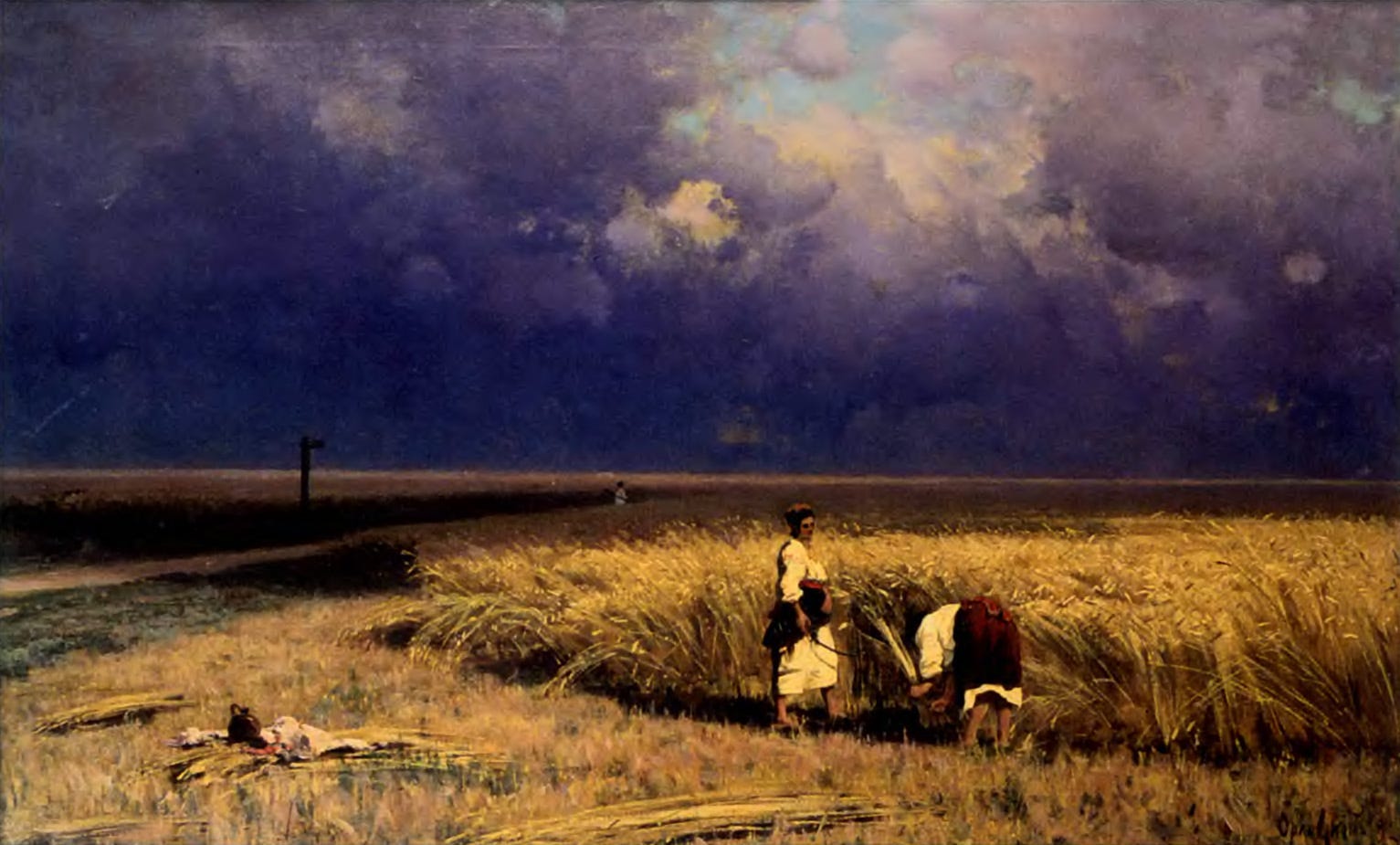
By the end of 2014 Ukraine is lurching into chaos. Russia has officially swallowed Crimea, after a ‘referendum’ boycotted by the peninsula’s Tatar population; fighting continues in the Donbas, where in September the separatists shot down a Malaysian passenger plane, killing all 298 people on board. (Putin blames Ukraine: it wouldn’t have happened, he explained, if there hadn’t been a war; we’re all trying to find the guy who did this.) But Putin is beginning to cool on the Novorossiya myth. Perhaps it took him by surprise that the rest of the south hasn’t mounted an insurrection. There were fierce clashes in Odesa, and forty-six pro-Russian activists died, but ultimately the city didn’t rise up. Maybe New Russian consciousness was confined, these days, to the Donbas. That summer the two separatist republics of Donetsk and Luhansk announced plans to unite as the Union of People’s Republics, or Novorossiya. They came up with a flag, a white-trimmed blue cross on a red background – wait, that rings a bell – and in December committed to building a new republic from the ground up. The December declaration was authored by a man called Boris Borisov, on secondment in the Donbas from his permanent home in a Bulgakov novel.
But the project fizzled. The two separatist republics remained separate, even as Russian troops poured in to co-ordinate their fight against the Ukrainian army. There was some truth, plainly, in claims that significant constituencies of modern Ukraine’s population felt great anxiety after Maidan, fearing that their linguistic rights and ethnic identity would be eroded, and that commitment to western transnational institutions would sever their commercial and cultural links to the nearby Russian Federation. The leap was the idea that this expression of separatism was really an expression of longing to be folded into Putin’s sphere; of being, deep down, Russians. Some people in Donbas (and, earlier, the wider southeast) wanted an independent, ‘transnationalist’ Novorossiya; some simply wanted to be left alone.
Excellent. Thank you.