
Location Correct
PickMe boys and girls of Sri Lanka

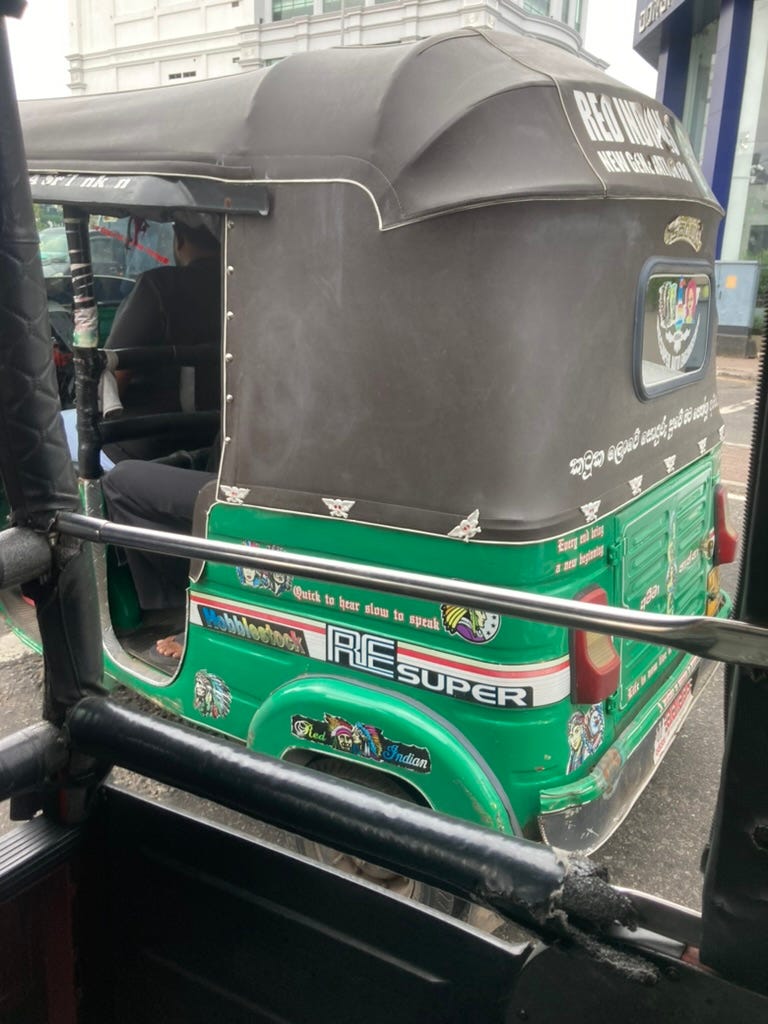
We travelled around Sri Lanka by train, car and tuk-tuk. Our favourite mode by far, the one that offered the best glimpses into Sri Lankan life, was the tuk-tuk. People call them ‘three-wheelers’ here, more so than in India. But just like in India, the drivers personalise their three-wheelers to reflect various aspects of their own identity. Religious allegiance is proclaimed in the windscreen: a Buddha cross-legged above the handlebars; a miniature Ganesh, hanging from a set of beads; a glow-in-the-dark Mother with her Child in her arms and her back to the road. In Galle a Muslim driver, having nothing so iconographic in his windscreen, gestured at the lavish New Year’s Day celebrations, shared by Buddhist Sinhalese and Hindu Tamils, and shrugged at me in the wing-mirror, as if to say ‘I don’t know, man’.
Most of the decoration is completely secular. One driver, rescuing us from a sudden sunset downpour on the Colombo pavement, pulled aside the rain-flap to reveal a passengers’ area adorned with plastic grapes, plastic flowers blinking with alternating LEDs, and in the boot behind us a sound system. RASTA, read the slogan on the green body-paint. The driver who took me to Sigiriya has a recessed Buddha above his windscreen, but changes things up towards the back. You just never know what will be printed on the laminated layer covering the seat and the inner side-pads; in this case, the Moomins. My favourite slogan of all, handsomely italicised, adorned a laminated illustration of two pirate ships cruising at twilight: came into this world with out rules…
An app called PickMe operates throughout Sri Lanka, a ride-hailing platform along Uber lines. It which includes tuk-tuks, and even the spare seat on the back of a motorbike, as well as cars. It’s efficient and reliable, guarantees you a fair price, and saves you from negotiating on the days when your negotiation-fuel is running low. But it has one quirk that sets it apart from Uber or any equivalent app in the west.
At home, the Uber reservation is in theory completely impersonal: the pick-up and drop-off, the price and the payment, are all handled by the app, and you only communicate with the driver if you want to, or if some part of the process has gone wrong. In Sri Lanka, as soon as a driver has confirmed your trip, he rings you, accessing your phone through the app. He almost always wants to know where you really are: location correct? But sometimes he has other questions: where you’d like to go, for instance – as if the app, having already formalised all that information, is just a front.
We became fascinated by why the drivers do this. We asked around but didn’t really get an answer, because it felt rude to ask the drivers themselves. Sometimes it was a tiny irritation, of the kind you brush off when you travel, chalk up to simple difference. Most of the time it was an intriguing puzzle.
It might be that there’s an economic reason we don’t know about, a strategy to prevent the app undercutting the driver, just like at home. It might be a response to the general awkwardness and blundering of the visitor, who doesn’t understand Sri Lankan customs of the road and so sets impractical pick-up and drop-off points. As far as I could tell, it reflected a Sri Lankan attitude to everyday life which noticeably differs from the attitude in the west. In Sri Lanka, everyday interactions are characterised by informality.
Everything is to be negotiated, improvised, worked out on an ad hoc basis. And this means that the sphere of the everyday in Sri Lanka is extremely personal (and, on good days, personable). There is no system to hide behind, no formalised mechanical structure to hold between you and the other person, a buffer against interpersonal communication. The mechanical structure – in this case, the ride-hailing app – is just a way of finding potential customers. It doesn’t seal the deal, or set anything in stone. All the deal-sealing and stone-setting happens in dialogue: over the phone, during the journey, and at its end when – in another striking difference from Uber – you (almost always) pay in cash.
There’s an Orientalist way of talking about the informality of societies like Sri Lanka. I came across it in India, many years ago, and I’ve seen and heard snatches of it here. Westerners will widen their eyes and talk about the total chaos of a railway station, the riots of colour in the spice-shops or commercial districts – and in the same sentence they’ll roll their eyes and complain, prissily, about the total incompetence of the waiters in their restaurant. Obviously the bad-tempered muttering is gross, but I always found the effusive riot of colour trope irritating too. It misses how much of life in this part of the world is strictly, even excessively regulated by codes of behaviour. It misses the importance placed on manners and social hierarchies. But it also misinterprets the total chaos as a deep characteristic, when it reality it’s a surface-level one, an apparent rather than inherent property of everyday Sri Lankan life.
What westerners mean by total chaos and riots of colour is really just that everyday life is informal – unregulated and improvisatory, in comparison with the west, less rigidly mechanised. If you exaggerate informality as total chaos you deny yourself the chance to take it seriously; you skate over its potentially life-giving, soul-restoring benefit, the feeling it produces – a feeling of ease, and possibility, and freedom.
It would also be Orientalist, though, to deny that informality has any downsides. One place where you might want things not to be negotiable is the road. Personally, I quite like the customs of the road in Sri Lanka, the way there are basically no rules apart from the imperative to swerve out of the way if you’re going to hit someone, and the use of the horn in a cheerful non-aggressive ‘behind you!’ sense rather than the rage-filled western ‘how dare that car question my masculinity’ sense. But the numbers don’t lie: terrible accidents happen far too often in Sri Lanka, and if the road was more regulated, they’d happen less.
What’s more, scaling everyday informality up to the level of a national society, and its government, produces terrible results. Informality, as eastern Europeans remind us, is the essence of corruption.
The Orientalist defence of informality ignores these perils. In an Orientalist attitude, it’s more important that Sri Lanka retain its charming character, its swirl of chaos, than cut down on road deaths; it’s positively troubling, meanwhile, to imagine the country ridding itself of charming backwardness and achieving true prosperity. And sometimes, as we experienced, negotiation-fuel runs low: a world where everything is always moving, always up for grabs, can be a tiring world.
A better defence of Sri Lankan everyday informality might move from the road itself to the roadside. All along our journeys we stopped for snacks and water, to stretch our legs or investigate a temple or waterfall. Everywhere we stopped there were roadside stalls selling water and woodapple juice, fried snacks and sweets; plastic chairs in the shade, other travellers taking breaks, locals buying something for the commute home, kids playing cricket in their school uniform. As the night fell with the signature abruptness of the tropics, the bright lights of the roadside stalls blinked on. They became little beacons of warmth, tableaux of low-key human interaction as we continued down the lonely roads through the suddenly pitch-black countryside.
When we stopped at these places, we’d just pull over wherever pulling over made sense. In England, it’s quite common that the only place you’re allowed to park is a designated car park, and that the designated car park is only accessible to those with a special app. It’s a completely normal occurrence, in England now, to see someone hunched in the driver’s seat in a car park, wincing with stress, watching their phone wolf through its data as the download inches towards completion. Our daily life has been so thoroughly enshittified by pointless mechanism – parking apps, iPads in coffee shops, e-ticketing services that glitch and randomly log you out – that we lose sight of the weirdness and recency of this concerted shift. The informality of everyday life here, and in many other places beyond tidy advanced western Europe, has a lot to teach us.
Last autumn, writing in anecdotal mode from Suffolk, I mentioned the research I was carrying out on enclosure. In English history the term primarily refers to the appropriation of commonly worked land, its conversion into large private estates for the purpose of economic ‘improvement’. Incidentally, enclosure of exactly this kind took place in Sri Lanka under the British Empire. The hill country around Kandy – ancient Sinhalese capital of the kingdom never subjugated by the Dutch or Portuguese, and only captured by the British in 1815 – had been farmed by peasants who also worked as labourers on the mixed, early plantations of coffee and tea. Their land was bought up, and turned into more efficient plantations focused on tea, to be worked by indentured labourers coming from Tamil Nadu.
In Suffolk, I wondered about a more metaphorical meaning of enclosure. I was thinking of Ali Smith’s Gliff, a dystopia in which being off-grid, or ‘unverified’, is to be an enemy of the state; the state responds by painting around whoever or whatever is unverified with a thick line of red paint. Writing likewise from Sri Lanka in a semi-anecdotal way, I can’t help of thinking about Sri Lankan everyday informality in similar terms: indications of a sphere of life that remains unenclosed, that remains highly personal and subject to negotiation; a sphere of life that has not been, and does not need to be, made mechanical.