
On Unvanished Land
An update from Suffolk

Hi All,
I haven’t posted any Night Thoughts in a while, as I’ve been scribbling away like a good child of day at some academic work. I’ll get back to posting soon, but I thought I’d send a quick update.
I’m in Suffolk at the moment, staying for a few weeks in a seaside town. (For my numberless hordes of international subscribers, Suffolk is a county in East Anglia, the part of England that bulges gently into the North Sea.) I’ve come here lots before, but usually in summer for a holiday. So it’s strange to be here in a cold snap at the start of winter, hunkering down with work to do. It’s a picturesque town surrounded by countryside of an unobtrusive but majestic beauty. And it’s a prosperous place, thanks to the summer influx of seasiders, day-trippers and second-home owners. Still, out of season it feels eerily empty, and you feel that emptiness especially after dark.
What we call the night is really three things, which overlap but never completely: the period of darkness following sunset, the zone of recreation or contemplation after the working day, and the hours of sleep. The darkness comes first, out here, closing in from four o’clock, the eastern sky over the North Sea blushing pink before it disappears. Lights flicker on: red and green beacons, flashing at the end of the pier, and the huge remorseless sweep of the lighthouse. But the little redbrick streets, lit sparingly, become a secret furtive warren, a film set of noises off and anonymous footsteps.
Walking around town in the evenings, I’m likelier to come across animals than people: a muntjac, startled in the headlights of my phone on the common; two rats shrieking in fright on the embankment. I pass the locked beach houses, packed together in a serrated row, their bright personalised colours fading to uniformity, and spy someone up ahead – but it’s just the safety railing, seen end-on. One front garden, overlooking the lake on the northern edge of town, features a man birdwatching, sitting on a bench with binoculars at his eyes. He rears into sight, and I flinch, even as I realise he’s a sculpture.
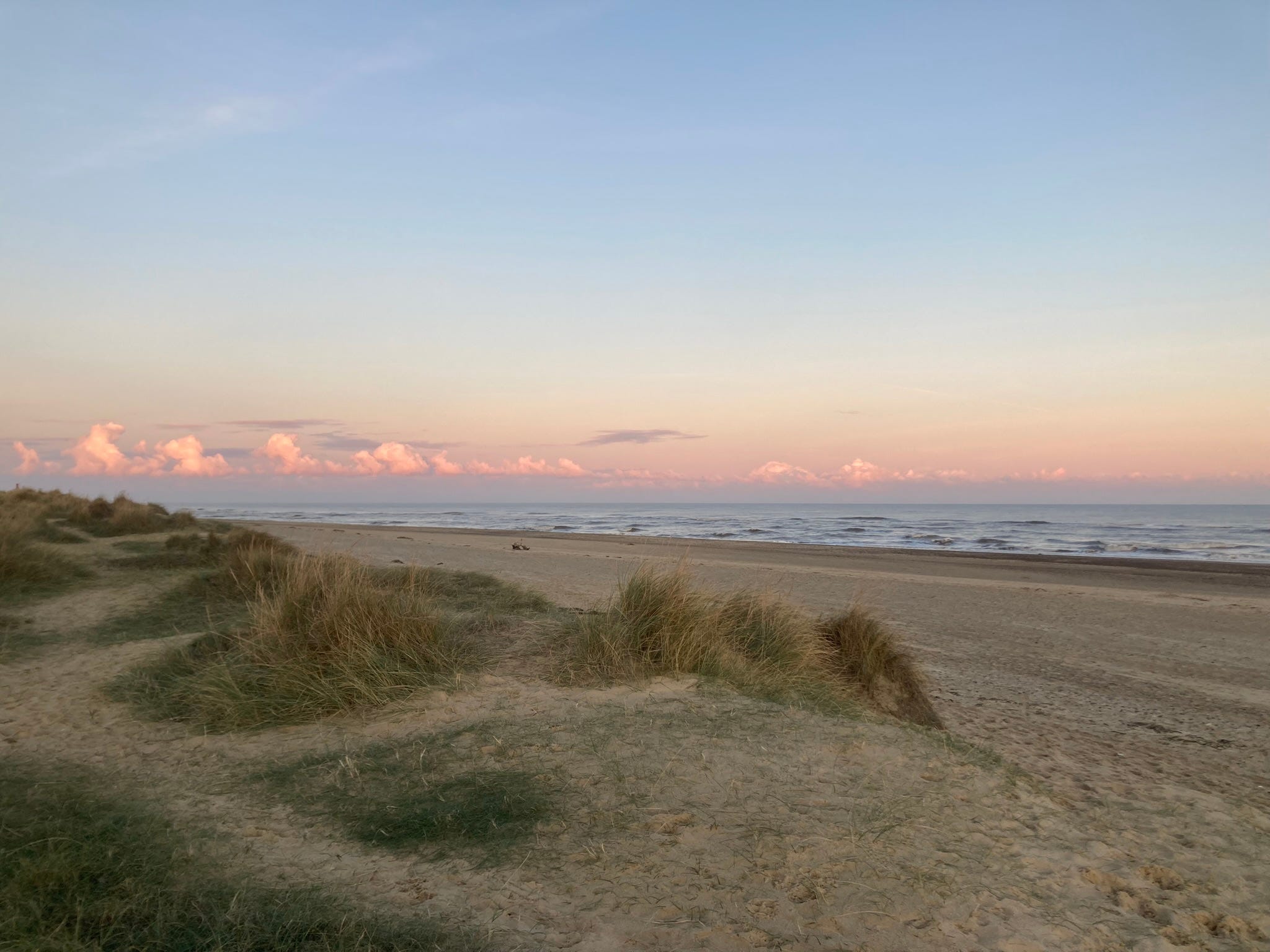
From the beach I look up at the proud Victorian townhouses facing the sea – a row of lightless windows and empty rooms, nobody at home. What has happened to seaside towns, even happy and prosperous ones like this, is an accelerated version of what has happened all over provincial England: settlements that once thrummed with activity, centres of their own gravity, have become places of retreat, in the high days of summer, or in retirement, or at the end of a commuter’s working day. Provincial England has gone quiet.
Night privatises us. House after house offers glimpses of warm contentment, little snapshots of snug domestic comfort framed by the void of the cold dark. An outdoors public nocturnal culture would be a liberating thing, but this far north, the early darkness comes with a chill. So gathering outside is reserved for special occasions – Bonfire Night, and Christmas, and freezing festive swims. But this reinforces the need for indoor public spaces where we can be together after dark. This town has its fair share: the cinema, small but perfectly formed; the public library; the pubs.
Enclosure and the Commons
One of the things I’ve been researching is the history and geography of the English commons. It’s a weathered old tale, of ancient customary rights to the land being gradually stripped away by the process we call enclosure, which accelerated in the late eighteenth and early nineteenth centuries. I was working on a piece about ‘commoning’ in recent politics. The English left, I argued, should do more to harness the energy of the commons, the commoning spirit of distribution of power to ordinary people, of trust in their knowledge of how to work things.
(Did you know: after the Soviets gave up on their ruinous policy of collectivisation, land started to be given grudgingly to rural workers in the form of allotments; these allotments were 4% of the Soviet landmass, but by the 80s produced half the USSR’s vegetables.)
Once I’d finished, I read Ali Smith’s newest novel, Gliff, and found that I hadn’t succeeded in escaping enclosure. Gliff is a riff on a classic dystopian novel, set in a Britain of the near future, in which sinister forms of advance have sent society backwards. A surveillance state sees everything, and designates what it doesn’t like as ‘unverifiable’. To be unverifiable, as the protagonists are, is not to mean anything – but in a classic Smithian paradox, this abjection also creates the freedom to be, or mean, more than a single thing. The state identifies what it doesn’t like in a startlingly literal way: it surrounds it with a thick border of red paint. A form of enclosure.
As a teenager, one of the things I found funny about the way older people talked was how spontaneous their lives sounded. You’d ask someone how they started working somewhere, for example, and they’d scratch their head and say that they just turned up one day and asked for a job, or were mistaken for the person the job was meant for. Life seemed to happen by accident: less curated, less enclosed. I recently heard stories from friends about talking to teenagers of today, who had exactly the same response to our generation’s anecdotes – of travelling spontaneously and casually through southeast Asia, say, with no fixed idea of where to spend the night.
Elites and Mobs
Maybe every generation feels more enclosed than the one before. But the forces of enclosure are on the warpath, like never before in my lifetime. Pete Thiel and his friends talk openly about establishing non-democratic corporate monarchies, where the sovereign manages his subjects by monitoring everything they say, and determining their desirability with AI algorithms. This is literally what happens in Gliff. On the way to Suffolk I stopped off at home, and we talked about how suddenly it feels slightly dangerous to write critically about Thiel and his ilk, for fear of their algorithms taking revenge. For us, for now, that’d mean trouble at the border, and we can live with that. For an undocumented Venezuelan it might mean deportation to a concentration camp.
In J.D. Vance, Thiel has his man in the White House. The Silicon Valley bosses have followed Thiel’s lead, sucking up to the Trump administration. Hannah Arendt calls fascism the alliance of the elites with the mob. But this dynamic is also at play internally, I think, within the ranks of the new American oligarchy, within the oligarchs themselves. In material terms, of course, Trump and his goons are nothing but elites. But their passionate style, so chaotic and venal, is all mob. And Thiel and his friends are so good at presenting as intellectuals. But what they propose is to abolish all the civilised inefficiencies of the twentieth century: democracy, the rule of law, human rights; all too staid and analogue for them. What they want is domination, and just because they propose to dominate with algorithms and not with guns, it doesn’t stop them being thugs. Trump, Vance, Thiel, Musk: the most dangerous men in the world.
Normal service resuming soon. There’ll be a bit more contemporary fiction, and a bit more on style; an exploration of the supposed personhood of chatbots; and (to show up that I really have left teenagerdom behind) maybe some posts on the brilliance of every Millennial’s favourite TV show. Until then, all best from the dark, beautiful east coast, and hope you’re keeping warm.
Wonderful….You write with such needlepoint precision Archie. Such an exquisite evocation of Southwold in the winter. And then on into a brilliant interpretation of what enclosure means in many forms….. Keep them coming through these dark winter months!
Resonates Archie! Enjoy Suffolk