
Glisse!
Thinking rough and smooth

A man is walking down the street, minding his own business, when he slips on a banana skin and falls over. Incensed, the man pulls out his gun and shoots the banana skin, which smoulders and turns to ash. The end.
This story was conceived, written and illustrated by my seven year-old godson, who described it to me as a story ‘about an overreaction’. The man falling over on a banana skin is the classic, archetypal comic image. But the overreaction, the immediate escalation to the drawing of weapons: that’s the genius touch. Daniil Kharms, the twentieth-century Russian absurdist, would have been pleased with it.
It’s a fraught business, walking down the street. So many potential collisions with bodies both moving and stationary, animate and inanimate. Then there’s the weird thing that happens when you look up to see an oncoming stranger, and try to get out of their way, but they go the same way, and you do a strange dance of inadvertent imitation. James Williams, in his excellent critique of contemporary tech culture, Stand Out of Our Light (2017), cites this as an example of ‘things that have no name but need one’. It might lack an official name, but Urban Dictionary has some beautiful suggestions: same-stepping, or sidewalk salsa. Williams observes that sidewalk salsa ‘somehow, miraculously, always manages to resolve itself’. You and your accidental partner shake your head, smile and laugh, wish each other well with a brief meeting of the eyes. The sidewalk salsa has occasioned a very fleeting moment of real connection in the anonymous thrum of the city.
For Jane Jacobs, the great American urbanist, bumping into people was to be desired. Jacobs noticed the way neighbourhoods that have been allowed to grow organically, with the participation of their inhabitants, achieve a constant equilibrium. In a multi-use neighbourhood different groups replace one another throughout the day, coming into contact and maybe even discord, but all the time maintaining the street’s life and therefore, Jacobs boldly argues, its safety. We could see the sidewalk salsa as a comic riff, or a gracenote, in what Jacobs calls the ‘intricate ballet of the good city sidewalk’, whose components are spontaneous and specialized – ‘life’, Jacobs says, ‘not art’, though ‘we may fancifully call it the art form of the city’.
Even without bumps – even at its most unhurried, on a pavement cleansed of banana skins or co-pedestrians – walking isn’t smooth or effortless. The natural human gait is an undulation, as well as a slight swaying from side to side, as you spring upward with one step and transfer weight across for the next. If you find yourself walking alongside a brick wall, you can focus on a single line of mortar and see it rise and fall as you walk along, a diagram of the undulating motion of your body. It’s the easiest thing in the world, but intriguingly hard to imitate. For all the extraordinary computing and engineering expertise in their creation, the robots shuffling around the labs still look deeply unconvincing: at the very best, like a person so drunk you’d call them legless, and at the worst unlike a person at all.
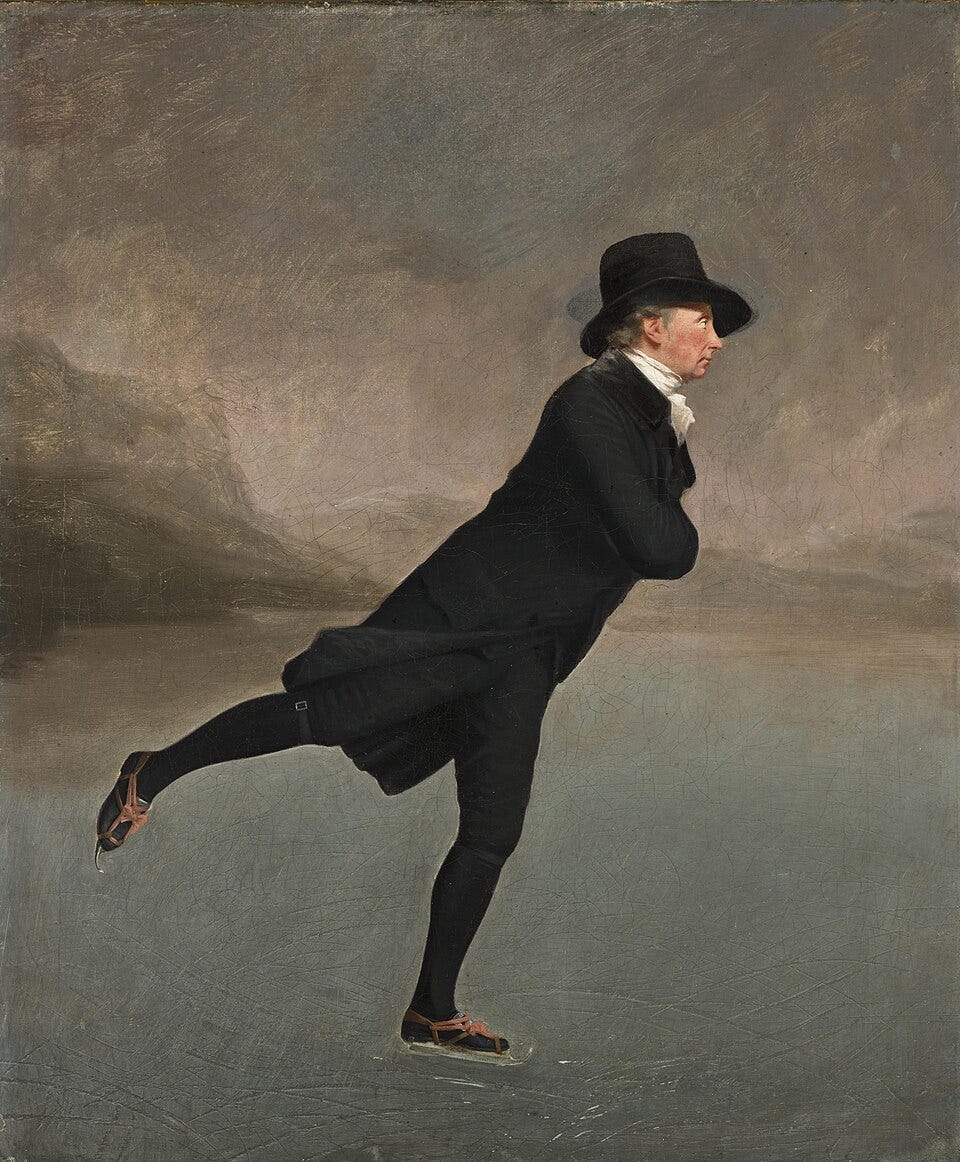
Maybe it’s the elusiveness of being truly smooth, while walking in the city but also while walking at all, that explains why people find such pleasure in the sensation of gliding. In French there’s a classification of sports de glisse, glidesports, which we might not associate together but which all have gliding motion in common: skiing, paragliding, surfing, skateboarding. In a recent article published in the Journal of the Philosophy of Sport, Sigmund Loland and Åsa Bäckström ask the million-dollar question: what is the phenomenology of glisse? Why does it feel so good to glide? All glidesports, Loland and Bäckström suggest, are characterised by a particular ‘movement rhythm’: ‘a concentrated phase of effort and force followed by the experience of effortlessness while being in a stable, balanced position’. Often this alternation registers in a change of sound, as in ice skating, where ‘the sharp sound of a skater’s edge towards the ice’ gives way to the ‘swoosh-like sound in the gliding phase’. The crunch of effort, then the swoosh of embodied freedom.
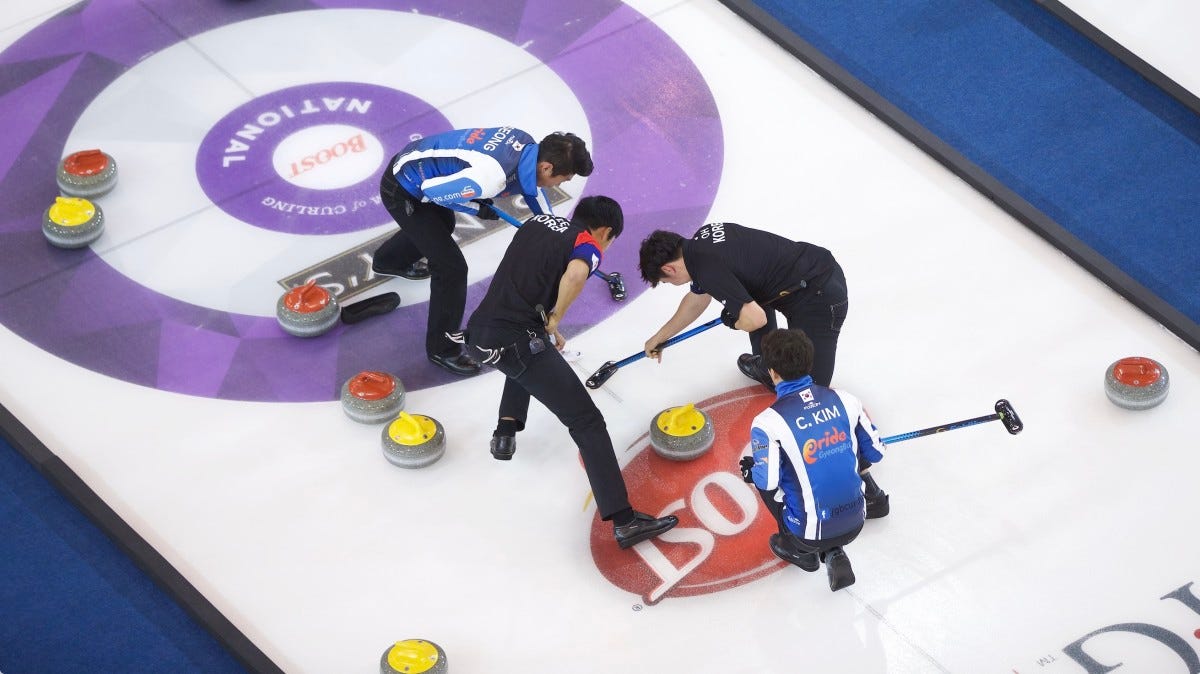
In light of Loland and Bäckström’s theory, curling is an unusual glidesport, because the friction and the gliding, the effortful and the free motion, occur at the same time. Curlers slide a smoothed and bevelled chunk of Ailsa Craig granite down an ice sheet, aiming for the concentric target (‘the house’) at the far end. The stone moves with the curl imparted by its thrower, but also by the concerted efforts of two sweepers, anxiously attending to the stone as it travels down the sheet, scrubbing around it frantically to speed the stone up or influence its direction. The stone and the curlers don’t fuse, like a skater to his skates or a rower to her oars; they move in disjointed parallel, the smooth silent stone and the frantic yelling persons. There’s something comic about this disjunction, and about curling as a whole – the impassioned yelling of commands, the sweepers scrubbing like apprehensive workers upstage in a musical – but something beautiful too. In this glidesport, unlike most others, what moves smoothly is not a human body but a heavy and cumbersome object made elegant by concerted human effort.
Once upon a time in European aesthetics, smoothness was an undisputed good. Classical aesthetics thinks that artworks should be gracefully balanced, with the parts subordinated to the whole, and all traces of composition or construction tactfully effaced. Artworks should represent darkness and discord, but it’s a fallacy to imagine that in doing so they should let their own forms be corrupted by the disorder of their content. It’s from these classical aesthetic assumptions that John Ruskin, the Victorian art critic and social theorist, tried to escape. In search of an aesthetics that covers artisan craft as well as high art, Ruskin argues against a preoccupation with what he calls ‘finish’ – a neat professionalism, a smoothing down of kinks and idiosyncrasies. ‘Finish’, he thinks, is the cultural logic of the mass production overtaking the world as Europe industrialises, the factories in which workers must make standard products, with any trace of their individuality effaced:
Men were not intended to work with the accuracy of tools, to be precise and perfect in all their actions. If you will have that precision out of them, and make their fingers measure degrees like cog-wheels, and their arms strike curves like compasses, you must unhumanize them.
‘The Nature of Gothic’, in The Stones of Venice II (1853)
As a source of humanizing resistance, Ruskin celebrates the Gothic art and craft of medieval Christianity. Gothic churches, with their weird and wonderful gargoyles and misericords, their unhomogenised ceilings, declare the individuality of the craftspeople who made them, as well as their imperfections – and therefore, in Ruskin’s Christian ethics, bestow ‘dignity on the acknowledgment of unworthiness’.
A writer who can articulate with such clarity and force why ‘men were not intended to work with the accuracy of tools’ is indispensable for our times. Ruskin’s championing of the Gothic is sounds a deeply pro-human note in a world governed by people who seem completely indifferent to the value of human life in itself, on the factory floor as well as the battlefield. But I think there’s room for a human-centric defence of smoothness. I don’t know whether Ruskin ever went ice-skating, but his account of ‘finish’ suggests that maybe he didn’t. The smooth glide achieved by a good skater or skier is impressive, I think, in a way distinct from the awesome power of machines to mass-produce identical products. Human gliding impresses us because the body, with its continual relaxing and contracting of muscles, is not naturally smooth. As Loland and Bäckström point out, the freedom of gliding exhilarates not because it transcends the laws of physics and the limitations of human movement, but because it creates free movement out of those laws and limitations.1
Addressing the Mansfield Night Art Class in 1873, Ruskin spoke about the town’s strong traditions of lace-making. As in The Stones of Venice twenty years previously, he argued from Gothic principles. ‘The real good of a piece of lace’, he says, ‘is that it should show, first, that the designer of it had a pretty fancy’. This takes firm precedence over a secondary good, which is the lace’s smooth and immaculate finish, proof ‘that the maker of it had fine fingers’. But couldn’t the fancy and the finish overlap? That is, what if the thing the lace-maker wanted to express was the miraculous distance between the naturally rough nature of their hands and the smoothly self-effacing piece of lace those hands could produce? Like the ice-skater, the lace-maker might want to express no ‘fancy’ in particular except the exhilaration of finding freedom within the body’s limits. But to Ruskin, I suspect, this is what distinguishes the athletic feat from the artistic (or artisan) work of art (or craft). The impressive achievement of the athletic feat doesn’t require the self-expression of the athlete. But perhaps an inexpressive artwork is no artwork at all.
This week I read Nicholas Carr’s excellent analysis of Mark Zuckerberg’s latest attempt to revive his beloved Metaverse in a tech landscape dominated not by Augmented Reality, as he envisaged in 2021, but by Artificial Intelligence. In the old vision you donned a headset and hung out with your friends in Horizon Worlds. Now you just talk to chatbots, some of whom have been programmed to speak in the voice of wrestler John Cena, or listen to your innermost desires, or flirt with you.
Two years ago, the Irish novelist Paul Murray wrote an article for New York Magazine about his experience of the pre-rebrand Metaverse. It’s funny, scathing and effortlessly poignant. Murray goes to the Soapstone, a virtual comedy club where audience members compete to be the best supporters, earning points by turning up and applauding. Everything is gamified, and there is no distinction between strangers and friends, public and private, weak and strong ties. This is social interaction designed by people who understand it unusually little, to whom it hasn’t occurred that most friendship is ‘grounded in some shared experience… a shared interest or illness or home or workplace’. The Metaverse, Murray suggests, points to the desperate lack of communal experience, and spaces conducive to it, in an increasingly suburbified America, ‘so huge and so lonely’.
Murray and his family rent a house in the suburbs, but don’t have a car, so have to walk everywhere. ‘I like walking as much as the next man’, he says, ‘but everything is slightly too far’:
Drenched in sweat, I think of the effortless glide of my Horizon Worlds avatar, his blithe hopping between worlds in the metaverse, which are always the same temperature as my air-conditioned office.
Murray doesn’t show us his avatar, gliding with uncanny ease through Horizon Worlds, but he does provide his own pictures of the spaces where he hangs out. Like the navigation through it, this world is incredibly smooth: blocks of saturated colour, discrete and sharply bounded, giving an impression of overwhelming flatness. It’s impossibly depressing and bleak. Smoothness in this kind of digital dystopia is the kind Ruskin feared, redolent of a total indifference or even hostility to human motion, human effort, and the beautiful smoothness it can produce. It has nothing in common with the exhilarating glide of the ice-skater.
Thanks to my godson, author of one of my favourite ever short stories, inspiration of this essay, and endlessly inspiring.
Loland and Bäckström draw here on the philosopher Aaron James. In Surfing with Sartre: An Aquatic Inquiry into a Life of Meaning, James outlines what he calls a ‘compatibilist surfing theory of freedom’. Compatibilism here is an approach to freedom that sees it as not necessarily in opposition to limitation or restriction; rather, the restrictions become creative constraints, indispensable to the freedom rather than mere trammels around it. ‘This is not freedom understood as limitlessness, however, but a pre-reflective, immediate and emplaced sense of freedom… the deterministic mechanics of the body-board-wave system and of the biological limits of human movement frame the surfer’s possibilities. To the surfer, however, the predictable framework works not as a limitation but as an enabling condition within which he can “trust” the world and develop his habits and skills in continuous and playful “adaptive attunement”.
Archie, I thought this was quite good -- lots of interesting things resonating. I completely agree with your thesis, and restacked. I always thought curling was a joke, but a few years ago I watched some, and found myself oddly, surprisingly even, compelled. I also used to be a pretty good skier, citizen races sort of thing, so I quite agree with sense of mastery. You don't quite say "second nature" but I think that's what this is about. Skiing is not natural. The first thing you have to do is get weight forward. "Gravity is your friend." So kinda trying to fall leads to control . . . I suppose it some sort of metaphor for maturation writ large, albeit a relatively pleasant one. Anyway, back to work. Good job!
really rather enjoyed that piece -- not least because I enjoy "glisse" myself, in various forms. Goethe, btw, was an avid skater. Wasn't there a Californian who thought there was something in us that craved gliding, and the side-to-side movement? I forgot his name, perhaps you recall it.