
Shooting Clean
Biathlon and the promise of noncritique

The Winter Olympics is reaching its conclusion. Snow is falling, thick and heavy, in Cortina. In England it’s been raining for days on end, and I’ve been watching the biathlon.
Men and women compete, sometimes together, across a blissful taxonomy of different race lengths and formats – individual time-trials, pursuit, mass start, and a 4 x 7.5km relay where instead of handing on a baton the skier taps their teammate on the back and then collapses in a drooling exhausted heap on the snow. They all share a core peculiarity: cross-country skiing round a gruelling course made of many inclines and precious few descents, punctuated by visits to the shooting range to fire at a row of five black targets, each the size of a CD, positioned fifty metres away. Biathletes ski with rifles strapped to their backs.
As a longstanding and expert authority on biathlon, and also as someone who has listened to too much biathlon commentary in the last 48 hours, I like to say sagely that everything can change at the range. Missing a target impedes your race in a way that depends on the format. They add a minute to the overall time for each target missed, or make you ski a penalty loop, or (my favourite) make you reload, unclasping one of three spares clipped to the side of the rifle, and fire again.
There’s something satisfying and fascinating about sports and games that ask for completely different skills. In rugby union the hooker spends most of the game in heavy contact, rucking and scrummaging, but also has to deliver twirling throws with pinpoint accuracy and perfect timing at the lineout. And after a change of innings in cricket the fearsome pace bowler emerges with bat in hand, reborn as an underdog, a gutsy tailender. What’s especially interesting about biathlon is that the two skills – cross-country skiing, and rifle shooting – pull in different directions, and get in one another’s way. The skiing part is about fitness and technique, the ability to keep moving with maximum efficiency as the body starts up its lactic howl of protest. The shooting part is about staying still, concentrating, executing a series of discrete and difficult tasks. Half the art of it is the transition: to slow down your breath as you enter the range; to go from the pumped-up physical flow of skiing to the Zen-like mental flow of aiming and shooting.
In this way it’s like poker, which asks you at the same time to be good at making quick mathematical calculations and at the same time shrewd judgments of human psychology – in a world whose problems derive in part, if not wholly, from the total breakdown of contact between calculation and judgment.
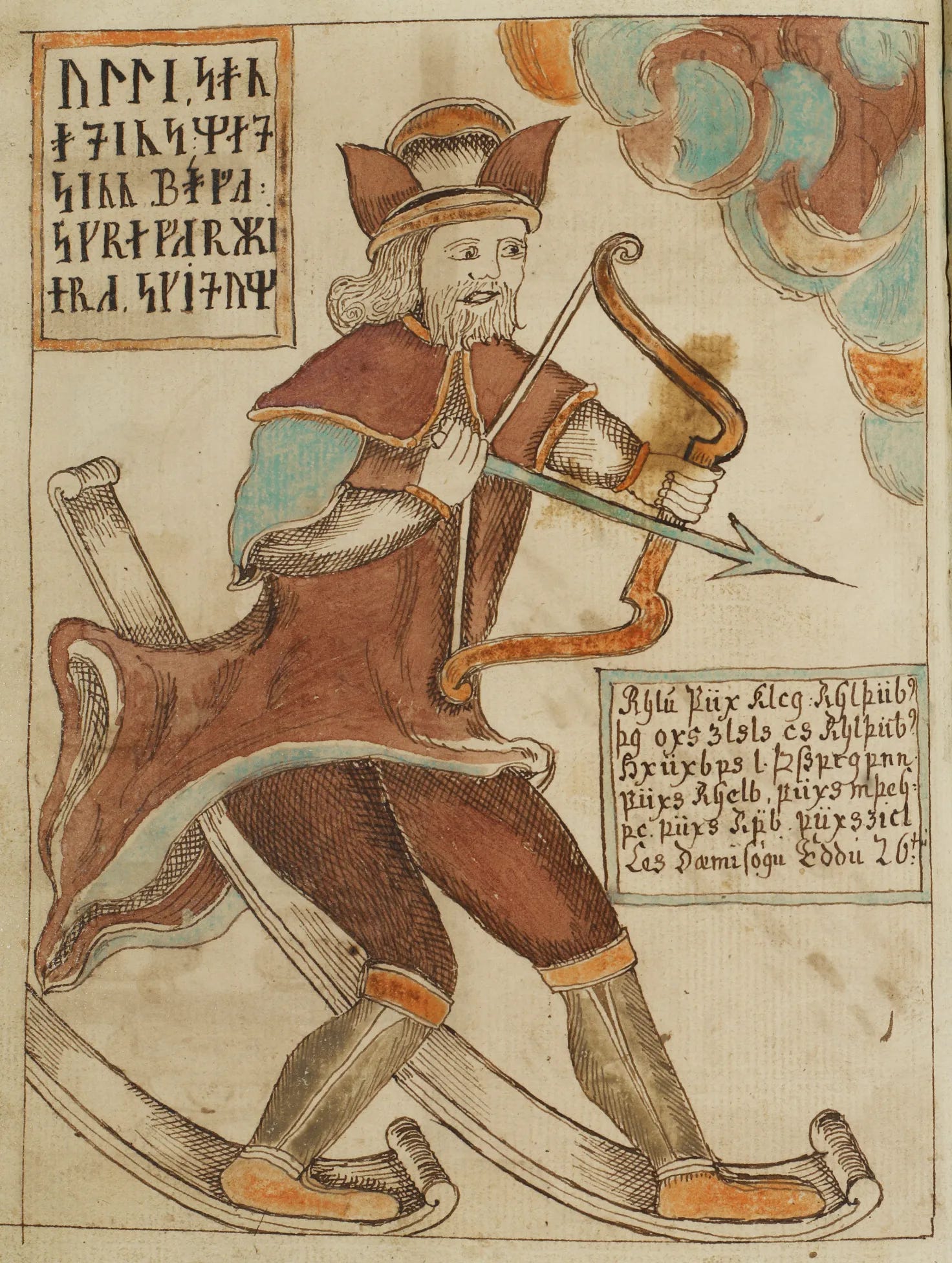
Biathlon has its roots in a sport called ‘Military Patrol’, which itself came from twentieth-century Scandinavian military culture. As a longstanding and expert authority, I have no need to peruse the biathlon Wikipedia page, but if I did, I’d probably also read that some historians of the sport have made speculative links with the Scandinavian god Úllr, associated with both skiing and hunting. As an Olympic sport it’s been dominated by Norwegians, French and Germans. America has sent plenty of biathletes to the Olympics but there isn’t much amateur presence in the USA, and this changes the meaning of the rifles. If biathlon were a popular amateur pastime for rich Americans, the sport’s connotations might be kind of gross, redolent of the stomach-turning Kristi Noem Sexy-Fascist-Huntress aesthetic currently in ascendancy. As it is, the rifles are spindly and scientific-looking and the vibe is earnest and professional, military in a non-American (or at least pre-Pete Hegseth) sense – lots of prowess and little peacocking. The deadly seriousness of the responsible nerd, not the crazed fanatic or overgrown child.
As I watch this parodically European sport I imagine (other) hardcore fans, spectating in its true homelands: flaxen-haired debt-free families gathered round the TV in a Norwegian fjordhytte; a woman studying Social Policy at a university somewhere in the Rhineland, following the 12.5km pursuit furtively on her phone in the library and itching to fetch her rifle up from its locked box in den Keller; a Eurocrat in transit from Strasbourg to Grenoble, catching the highlights in a bar where no one has smiled for ten years. When I was a kid, my parents bought a Freeview package which included, to general surprise, Eurosport. On Saturday afternoons in the spring and autumn my Dad and I would watch the rugby internationals. After they’d ended, without telling anyone, we’d sometimes switch over from the BBC and catch the biathlon. The camera would zoom out to show the inclines in their true severity, the skiers strung out in one-piece suits of brashly bright colours. Then we’d zoom in on the range, and the screen would split: on one side, the tucked faces, frowning in concentration; on the other the black targets – sombre versions of rubber ducks at the village fête – which at the touch of the invisible bullet would flip back, triggering and attached paddle which flew up and, as if by magic, turned the black circle white.
I think the guy who has been commentating for the Olympics might be the same as the guy who commentated on Saturday afternoons back then in the early noughties. He gets invested in everyone’s visit to the range, hoping in a tense undertone that they ‘shoot clean’ – hit every target – and when they make mistakes he says ‘oh, what a shame!’. As he observes, it’s a sport made for television.
Everything can change at the range. When the guy exclaims about it being a shame, it’s because he knows how costly mistakes with the rifle can prove. Biathlon’s binary structure means that momentum shifts very gradually – chipping away doggedly at the lead of the skier in front, pursuing them up the hill – and with fatal suddenness, as two mistakes at the range slap two minutes or three hundred extra metres on your time. The commentator is adept at quickly calculating consequences and telling us exactly what mistakes mean. You’re in medal contention, and then your race is run.
But this preoccupation with meaning, this impressive ability to situate unfolding events in context, is the precise habit of mind that seems absent in biathletes. As they pull away from the range their faces reflect neither triumph nor disaster, just the same determined clench of the jaw and focus of the eyes on the next stretch of cross-country. If they placed your shooting in context, started self-congratulating for sitting pretty, or castigating themselves for having thrown away all their hard work, they’d lose the concentration needed to haul the body in rhythmic but effortful fashion up the next incline. If the mind wanders from the range, beyond its meditative work of controlling the breathing, the body starts to twitch and jerk and the black targets stay black.
This ability not to think widely and contextually, not to add instant meaning to what is happening, has emerged as the special and noteworthy quality of the athlete. Anyone who has played sport knows the importance of silencing the inner critic, the voice that starts to spoil your inner monologue with negative assessments. But it goes beyond this, I think. The athlete is always trying to find a state of flow and remain there for as long as possible – and this involves the ability not to think thoughts of any kind, positive or negative, apart from thoughts addressed to the task at hand. What the athlete exhibits is not so much ‘positivity’ as ‘noncritique’: a refusal to verbalise, narrativise or in some other way give context to what they’re doing.
In sportswriting, the hallowed original of this argument is David Foster Wallace’s essay about tennis autobiographies, ‘How Tracy Austin Broke My Heart’. Why do I keep buying and reading these books, Wallace asks himself, when they’re so ridden with cliché? Why does Tracy Austin describe the biggest point of the biggest match of her life with language that’s totally banal and colourless? The answer, Wallace says, is not that Austin’s unintelligent and her ghostwriter’s bad at writing. Really it’s because of a quirk in Austin’s character, a quirk that means that the clichés are bizarrely appropriate: Austin has the ability, when playing, to think of nothing; what’s going through her head really is nothing at all.
The essay ends on a beautiful ambivalence, positioning Austin as both mystic and idiot. Elite athletes are ennobled by an extraordinary gift – in another celebrated essay, this time on Federer, Wallace speaks of ‘the body’s grace’ – and at the same time hamstrung by the disability of being under-average ‘blind and dumb’. In its own context (the essay was published in 1994) this ambivalence makes sense: it was only a couple of generations since the professional athlete, with their ruthlessly single-minded focus and monomaniacal willingness to win, had replaced the amateur with his (and it mostly was ‘his’) gentlemanly good humour and graceful disinterest. Professional athletes perhaps seemed of a piece with the other kinds of fanatic in whom Wallace was interested: the American salaryman, turning themselves into a robot in service of a corporation which gave them material comfort while killing them inside; and the American addict, chasing a single destructive pleasure at the cost of all others.
Things have changed: culture has grown digital to such an extent that the world’s most powerful corporations have begun to turn from reality itself, the sphere of corporate boardrooms and compulsively pleasurable substances (to say nothing of the less marketable sphere, the sphere of grass and snow, food and drink, sex and company, art and sport; about this stuff nothing is all the overlords of these companies have to say). Today the enticements are online: AI companions, gaming worlds less drab than the depressed suburbs, and scrolling feeds so entrancing that the scroller goes several hours without feeding on actual food. In this world the athlete suddenly seems radically countercultural. Look at me, says the athlete, entirely in my body, oblivious not just of the distractions in the screen, but also of the screen’s reports of what’s happening out there in the world; oblivious even, of my own looming destiny, the impossibility of making up for my lost time. The world is being taken over by people who want us to believe that consciousness could one day be disembodied. We zoom in on the biathlete’s face, spittle-flecked and locked in a grimace, a flow state of the most punishingly European and least Californian kind. Not so fast, says that face, not so fast.
...and "glisse"!