
Rooney's Return
Reflections from Florence, thirteen years later

Things had changed in Italy, our driver said. He glanced at his two passengers in the mirror as he steered us winding through Chianti vineyards. Judging our vibe, choosing his words. The big cities, he said eventually, even some of the towns, were overrun with foreigners. Not like the two of us, suncream-slathered white people from northern Europe. Africans, he meant: the young men wandering around in faded t-shirts and jeans who’d survived the crossing.
He was eager to help, kind and friendly. He told us about growing up in Sicily, how he’d been ten years old, sitting drinking a Coke, and someone jumped from a car and he saw a man murdered – a customer in the same café, shot in the face. That was enough, his mother decided; she took him and his brother up north in search of a better life. Now he’s twenty-three and on the move. He spends only the summers in Tuscany, returning to his family. The rest of the year he lives in Switzerland, working as a driver in a luxury ski resort. High up, beyond the reach of all the madness.
He was a UFC fan, a boxer in his spare time, but we were welcome to smoke in his car. If he looked skinny, he said, it wasn’t for lack of training, just the effects of the cigarettes. He hoped for a girlfriend – but it was difficult these days, he reckoned, finding a good woman. He asked us polite questions about ourselves and offered us complimentary mini-packs of Nutella-based snacks.
We met others like him across Tuscany, in bars and taxis and hotels. Young men hungry for the world but locked into austere routines. Work all day, then gym in the evenings. A fear of getting stuck in this comfortable old region, a fear of sinking into the land, saturation by its famous food and wine. They liked the sound of London and some of them had visited. But the city they dreamed of, their image of a more prosperous future, was Dubai. Escaping the matrix, our driver said.
I wondered who the Italian equivalent of (or successor to) Andrew Tate is. It seemed to me that these men are being suckered. They have good reasons to distrust the established trajectories. Why study for a profession when the study consumes so much time and money, when the profession pays so modestly and the cost of living only climbs? But the only alternative they know – their way out, their route to Dubai – is the hustle, the grind of shift-work and gym. The reality of the hustle is that unless you have connections, or happen to hit the algorithmic jackpot, you’ll end up working more, not less. Poor suckers, I thought. Then I thought about being a freelance writer, and reflected that most of my published work, including stuff I publish here, is basically the same: writing for little or no material reward, in the hope that an eminent consciousness or an all-powerful algorithm will pluck your piece from the pile, bestow on it the aura of visibility. Whisk you off to Literary Dubai, which is an oxymoron, but you get the picture.
One guy, a friend of our boxer, picked us up wearing a stylish check suit with his hair slicked back and freshly washed. Later he’d be taking clients to a concert, he explained, so he had to look the part. He hadn’t bought a ticket but he was looking forward to listening from the car. I imagined him reclining in his seat, open-air arias wafting through the window as he scrolled on his phone.
We were heading for Florence. I told our driver that I’d stayed there a couple of months, when I was his age. He laughed and shook his head. I wouldn’t recognise it, he said. He wished us a lovely time, recommended spots for gelato and bistecca. But he told us to be careful. The city, he said, it’s not safe anymore. Then he asked how old I was. I’d surprised him with my talk of ages. I told him the truth and he smiled encouragingly, said he’d have guessed lower, as low as 27. For a moment I felt flattered and then he cheerfully remarked that I looked like Wayne Rooney.
He was wrong about Florence, it turned out. Florence hadn’t changed at all – still richly, extravagantly beautiful. The bridges, the palazzi, the chapels and their frescoes: all intact. If there was a foreign plot to take over the city, the city was winning.
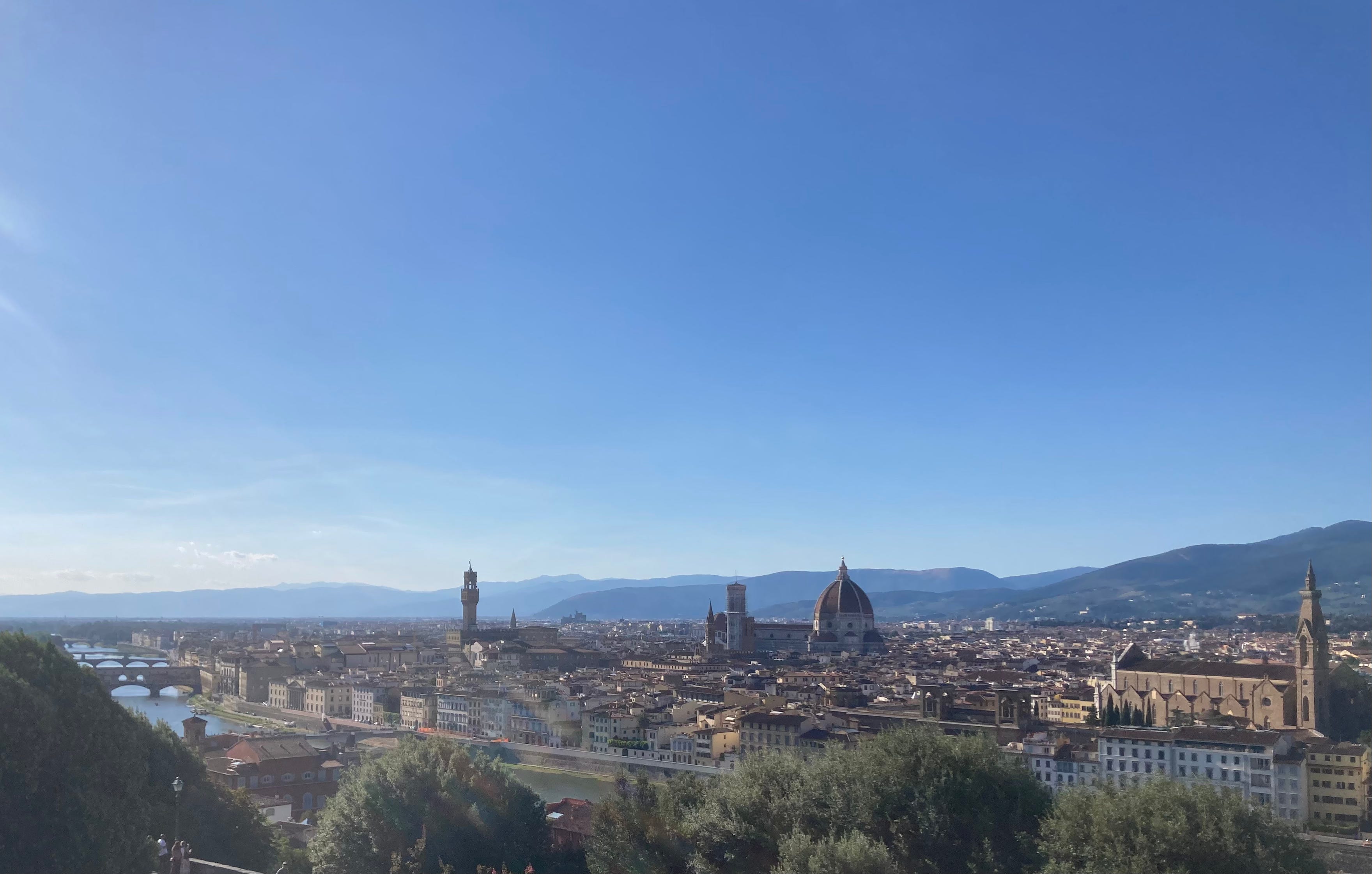
I was back for the first time in thirteen years. I’d fled there after finals for six weeks of Italian and history of art: how to order ice creams; how Brunelleschi built his famous dome. One night I came home drunk, lay down in a spinning room and couldn’t stomach the spin. I thought a nightwalk would sort me out, so I stumbled down into a scantily lit Oltrarno and crossed the Ponte Vecchio into the centre. Three in the morning and the streets deserted – except for the African men who sold trinkets in the squares; their trinkets stowed away now, their display blankets folded as they sat chatting quietly in the cool night air. After half an hour of unsteady marching I found myself in the colonnade of the Lungarno. A voice called to me from the invisible wall. English boy, it’s late! Go home!
Thirteen years later, on an evening walk up to San Miniato, we paused at the Piazzale Michelangelo and looked over the city. The Arno, gliding away from us towards Pisa, its bridges seeming to shrink and narrow as perspective took hold; the city alongside, palazzi of various ages but uniform height, one decorous smooth skyline dominated by the Renaissance cathedral and the medieval tower. It looks (said a Person of Interest) like a city from the past.
Tourism is nothing new, of course. As early as the sixteenth century artistic impressions of Florence’s skyline appeared in print. Grand Tourists approaching from the south clapped eyes on a real city they’d first known in representations. Hype, and mimetic desire, and even network effects: all these things existed before the Dark Ages supposedly ended with the invention of the computer. But the ancientness of Florence – the miraculous way it has stayed true to its early modern identity without ossifying into a museum, absorbing later developments with a grand, graceful lack of deference – served on this visit to show me what had changed, in the years since my weeks of falteringly describing my brothers and sisters and drinking red wine in Santo Spirito. Not the Africans; that story’s a sideshow, a distraction tactic, a dangerous lie. The real change was the way people took pictures.
They photographed the medieval tower and the Renaissance cathedral. They photographed the statues in the Piazza della Signoria – yellow boxes popped up on their screens, enclosing the stone faces. They risked injury to stand in the ludicrously unpedestrianised streets, cupping famous buildings in their hands. They captured bits of text: slogans scrawled rebelliously on the rustico walls of Europe’s first investment banks; inspirational quotes stickered on bridges. They photographed their food, cones of more-ish gelato and cardboard trays of one-and-done trippa and platters of extravagant post-woke T-bone steak. In the food hall of the Mercado Centrale one tourist marched steadily from display to display (meanwhile, weighing up her options, the Person of Interest dithered in delighted agony) photographing everything under the glass with the thoroughness of an official conducting an audit. Abstaining from the food, so as to fully glut his phone with the sight of it.
Most of all they photographed the art. They trudged through the Uffizi capturing picture after picture. In quieter rooms they made quick appraisals, scanning the works of quattrocento B-listers, their phone-holding hands tremoring with indecision: do these make the cut? In the showstopper, Botticelli’s hall of fame, they waited patiently in front of Venus and Spring and the Madonna, edging through the knots of onlookers until they had a clear shot. First the whole painting – framing the frame – then close-ups, zooming in on flowers, gestures, expressions. They photographed the explanatory labels beside the paintings, the busy twin long galleries of the museum and the oblong of air between them; they photographed the counter where you pick up an audioguide.
The presence of the photographer, says Roland Barthes, signals the disguised presence of death in a society obsessed with cheating him, shutting him out. The Florence of 2013 – when I was the driver’s age – would already have struck Barthes with its deathly intensity of photography. It was less common back then to take photographs in galleries, but it wasn’t unheard of. The decisive uptick in smartphone ownership had already occurred. Considerations of physical or digital storage, concerns about the indiscretions of flash and whirr, had fallen away.
I took hardly any pictures in 2013. Partly because I was late to the smartphone party, partly because I couldn’t see the point. Florence’s seeming eternity, its unspoilt grandeur, suggested to me that I’d soon be back. When you’re young all those cautionary tales about best-laid plans seem like nothing but bad-faith excuses. You find a life-restoring city full of beautiful things and scoff at the idea that it’ll take you thirteen years to return. Your melancholy is grand, self-absorbed, totalising and quasi-spatial – a gloomy domed chapel to spend time in. The only kind of melancholic thought off-limits to the young person, staring in solipsistic rapture at an artwork that strikes them as miraculously contemporary, concerns the passing of time: the reflection that this might be their one and only encounter, that they might never come this way again.
Despite his reservation about its deathliness, Barthes would have understood the kind of photography I remember from my first time in Florence. It had a kinship with the photography which preceded the advent of smartphones, or even the digital age. It was founded on that mature awareness of time’s finitude, of the intersection of time and distance. Your inner child delights in a beautiful artwork, briefly oblivious to the passing of time; your responsible adult self takes a picture, so that once the delight abates, once you’re thrust back into the flow of time, you have the consolation of a second look. Photography sooths the pain of leaving, the necessity of bringing that elastic but bounded moment to its end; it offers for the fleeting moment a permanent copy, a memorial of the encounter. The risk is the encounter’s slight dilution, the dulling of its intensity. Photography follows up the anticipatory desire to see, and the oblivious delight in seeing, with the retrospective satisfaction of having seen.
Thinking of my classmates from 2013 – comrades in vocab tests, DIY-fresco-class, and drinking in Santo Spirito – I don’t remember much talk of Instagram. We were all heavy Facebook users, but the main currency of social media was text. Group photos appeared mainly for the fun and games of the tagging and commenting. Not living under a rock, I knew you could turn the camera on yourself, but I’d first heard the word ‘selfie’ only the previous summer, in 2012.
The intertwined ascents of Instagram and the selfie have produced a fundamentally different kind of photography from 2013. Only the serene permanence of Florence, and the lapse of time between my last visit, revealed the novelty in its starkness. In Botticelli’s Hall of Fame a father turned his back to Spring, placed his arm round his son, and crouched beneath his outstretched arm. Father and son took their place beside Zephyrus as he reaches out to grab Chloris, arrest her transformation into Flora. The selfie converts everything into backdrop (the same way, maybe, that podcasts convert all discussion to background noise). One weird consequence of this is that paintings and buildings become like one another. Relegated to the status of backdrop, the façade of Santa Croce acquires the two-dimensionality of the canvas; similarly confined, the canvas loses its power to create its own space, its own depth. It becomes something purely decorative: a square in a grid of squares, a pretty tile.
At the same time, Instagram has conferred on certain locations a powerful fascination, a shrine-like magnetism, that far outstrips anything of which the sixteenth-century skyline-printers could dream. Everyone climbing the stairs from the cloister in San Marco exclaimed when their ascending eyes met Fra Angelico’s Annunciation. But their exclamations contained more than just appreciation, awe at the image’s arresting beauty. They were also expressions of recognition, the uncanniness of seeing something for the first but also the umpteenth time. (Not so much Mary on her veranda, surprised by an angel from heaven, a bolt from the blue; more Mary Magdalene in the garden, thinking you look very familiar.)
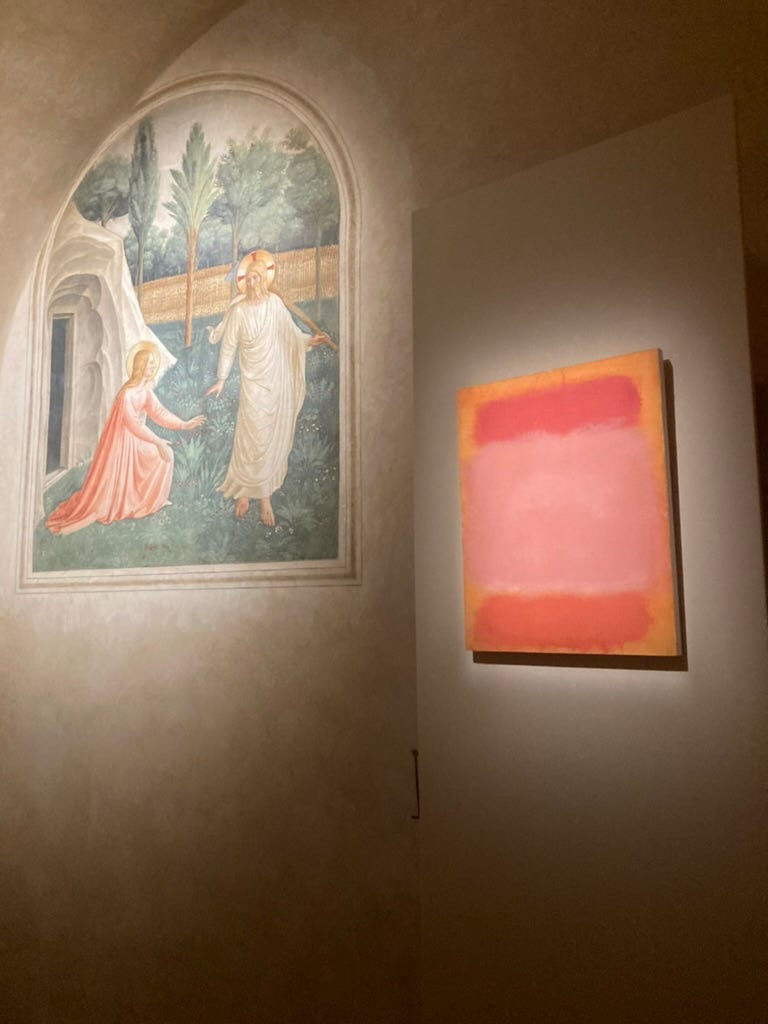
What felt different this time around isn’t just that this shrine-like focus now extends to pop-up restaurants and random boutiques as well as frescoes – on the Ponte Vecchio a long line of tourists snaked from one jewellery shop, ostensibly identical to the custom-starved jewellery shops around it; ours not to reason why, the algorithm knows – but that the relationship between the real thing and its representation has become totally scrambled. With its close-up candour and salivatingly high resolution, Instagram claims to offer the captive scroller not representations but rival hyper-realities. It’s for this reason that the app eats paintings for breakfast. When the distinction between reality and representation erodes, everything collapses into the category of flattened images.
This scrambling is so extensive that the two-step quality of older photography is also eroded. In the older photography, a moment of delight, pure momentary rapture before a beautiful reality, comes to an end with the creation of a memorial image. In the visual regime imposed by Instagram there is no unmediated reality and so there can only be one phase, in which flat images are produced from material surfaces captured quickly enough to abort their imaginative animation into three dimensions. Rather than effecting a transition – from the desire to see, through the delight of seeing, to the satisfaction of having seen – Instagram’s regime spreads a single mode across the whole of visual experience. A new hybrid of desire and satisfaction: not the desire to see, and not the satisfaction of having seen; instead, the intense and hungry desire to have seen.
The result is that the whole city, its palazzi and churches, markets and bridges, chapels and galleries, becomes raw material, the stock from which images of seemingly higher resolution, higher reality, might be made. Exploration becomes a kind of image-mining, a hunt for hyperreal images sharpened by the always-on vigilance of the hustler. The tourist’s gamble is that new sights and experiences will provide as much refreshment as the purer, simpler rest of the beach. Instagram sends the tourist into a city it slyly flattens, tasking them not just with the appreciation of the city but also its conversion into reality. It puts them to work.
When I arrived in Florence in 2013 Kate Middleton was nearing the end of her first pregnancy. Every day the Italian press built the speculation. The night the royal baby was born we were approached by several curious Florentines, asking for our views and whether we liked the name George. I remember finding the intensity of the coverage odd but charmingly innocent. Looking back – as the Prince born that summer becomes a teenager, and whole swathes of Europe burn in disastrous wildfires – it seems a comforting relic of a less frightening time. Europe’s had a rough few years since 2013. It’s a story of economic malaise, of real wages stagnating while the cost of living rockets, and all the political trouble which only the far-sighted, mocked and dismissed, predicted as a consequence. But that squeeze has coincided with astonishing advances in digital technology. The constantly updating phones and apps long since stopped pretending to have anything to do with social progress, but at least you can watch videos of someone eating pasta in a faraway city: quicker, louder, and at higher resolution than before. We have grown poorer in everything but the quintessentially melancholic experience of looking at what we can’t have. And when we travel round the world and try to grasp it, we find it effaced, worn away, its reality chiselled off and smuggled away in the silicon chips of a million individual smartphones.
In the summer of 2013 Wayne Rooney had just won the last of his titles with Manchester United. Tensions had risen with his manager, Sir Alex Ferguson, and he wondered whether he should leave. He was one of the best attacking players anywhere, the world at his feet. He was twenty-seven years old. Our driver was ten, or thereabouts. Somewhere on the east coast of Sicily, he sat down at a roadside café to enjoy a Coke.
well done. I expect I am not the only reader this really connects to.
I think some places such as Florence it is better to visit rarely, so as to better take the measure of them and the time that has passed. When I started being more interested in taking pictures, as a 16-year-old, I became intrigued with taking pictures of Japanese tourists taking pictures. They seemed alright with being inflationary about images back then already. We thought Kodak sounded cooler than Fuji film, wondered whether they had cheaper film, and didn't trust what they were doing. That was then.
Very engaging Archie! Loved it.