
Inner Redcoat
I'm just playing, America, you know I love you

When I was ten Bill Gates came to town. His helicopter landed near my school, on the playing fields over the road. We clustered at the gate, craning our necks for a glimpse. The Famous Nerd was flying in to open an eponymous computer science lab, one of countless endowments in aid of knowledge advancement, but I only know this because I looked up his visit on Google (not Bing; sorry Bill). What I mainly remember is Miss Patterson, standing head and shoulders above me, screaming in mock-fervour, Oh My Gaaad It’s Bill Gates, The Richest Man In The World!
That was 2002: Coldplay still just about OK; Arsenal’s trophy cabinet clattering with silverware; Bin Laden on the loose. A different time.
Today the richest man in the world is Elon Musk. A Famous Nerd of a contrasting sort: he’s now in his third consecutive summer of trying to incite race riots in the United Kingdom. Trying and succeeding. After the murder of Henry Nowak and its disgraceful handling by Hampshire Police, and after a Sudanese man assaulted and almost beheaded a man in Northern Ireland, we’ve had violence: in Southampton, clashes with the police; in Belfast, full-on pogroms, mobs of masked men directed by dinosaur paramilitaries to set fire to property of anyone who isn’t white – as if Turkish barbers and west African care workers and Ukrainian refugees are all part of a shadowy network called The Foreigners, whose orders the Sudanese man was following when he pulled out his knife.
It didn’t start with Musk, but if it continues and someone dies, burned alive in their house or beaten to death by the rampaging hordes, Musk will be partly to blame. His acquisition and rebranding of Twitter as X has turned an already annoying and fractious platform into the most powerful info-weapon the digital age has ever seen, a far-right psyop whose algorithms expertly prey on the worst fears of confused, pissed-off British people. At Tommy Robinson’s ‘Unite The Kingdom’ rally in 2025, Musk spoke via videolink, to crowds composed not only of thugs. Ordinary families too, by the looks of things: kids in Union Jack facepaint; parents terrified for the kids, what The Foreigners might do to them, the grooming gangs of the towns and the lawlessness of the big cities.
Incitement’s raw material is disinformation, and its primary engine is video. Clips stripped of context, where the stripping somehow makes them more, not less reliable; clips of moped-riding phone thieves, clips repurposed from the Rotherham abuse scandal, clips of Musk himself, saying that until the immigrants came the people of the UK lived like hobbits, smoking their pipes and eating nice meals.
We’re living through a grand social experiment, where we see what happens if video clips become a culture’s primary discursive form. Perhaps the viral clip’s lethal power rests in its weird combination of the experiential and the external, the near and the far. Scroll through enough clips and you start to forget the mediating element; you think you’re seeing the moped-riding thief steal the phone with your own eyes. At the same time, only the most incurious spectators fail to be enticed by an opportunity denied to all our numberless ancestors right up to the advent of the camcorder – the opportunity to see intimately into the moving lives of faraway others. So the video clip apes both the apparent infallibility of the senses (I saw it with my own eyes) and the apparent objectivity of news from elsewhere (studies show). We ought to realise that something claiming to be both subjective anecdote and objective empiricism can be neither, that these ethereal pseudo-anecdotes tell us basically nothing. But that realisation turns out to be strangely difficult in any circumstances, and especially when the world’s richest man tweaks the algorithm to pump with relentless intensity his clips of choice.
One example of a person absolutely suckered by viral clips is the Vice-President of the United States. J.D. Vance spends significant chunks of his life online, watching videos; just like the rest of us, that is, except J.D. has genuinely more important stuff to be getting on with, and unlike the rest of us holds sufficient power to interfere personally in the governance of foreign sovereign nations. Vance is obsessed with the United Kingdom and absolutely convinced by the myth of its societal collapse. That collapse is part of a general ‘civilisational erasure’ of Europe as a whole, but the UK preoccupies him.
One of the sanest things I’ve read on this platform in recent weeks is Fraser Nelson’s ‘J.D. Vance’s Britain Does Not Exist’. Nelson takes apart the claims patiently, systematically, with data and detailed graphs. Immigration spiked recently, but rates of serious crime have continued to fall. Immigration itself is now going down, and there’s absolutely no evidence for a correlation between any ethnic group and violent crime. But when I imagine Fraser Nelson confronting J.D. Vance (in a conversation, not a UFC bout at the White House octagon), I picture Vance swatting away the graphs and figures, pointing instead to the iPhone bulging in his pocket. It recalls a moment I’ve written about here before: the concerted ambush, at the White House in the first months of 2025, on the President of Ukraine. President Zelensky entreated Vance to visit his country, see the reality of the war for himself; Vance shook his head, drawing a phone with his hands, saying he’d already ‘seen the stories’.
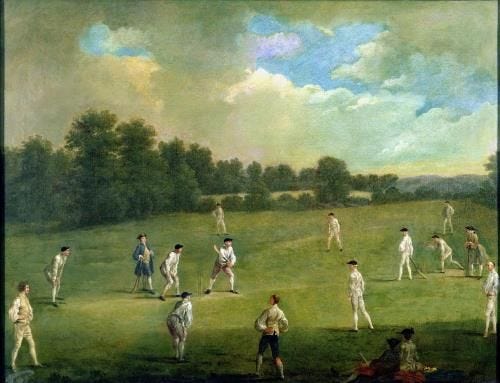
The European reflex towards anti-Americanism sucks: it’s nauseatingly pious and transparently false, built on an outrageous myth of our own cosy innocence. I love America, despite everything. Its optimism and dynamism have brightened my life. More than any other national tradition, you could argue, American twentieth-century art gives shape to the modern experience. But there’s nothing like Musk and Vance for awakening the Inner Redcoat. Most Brits have an Inner Redcoat, deeply buried in a state of permanent hibernation, stirring only when an American says they could care less, or calls football soccer; stirring gently, but settling back to sleep. Until these goons pop up, interfering in our politics, inciting violence, sullying an entire nation with libellous smears – and the Inner Redcoat rouses, and leaps to its feet, and tells these pathetic losers to take their robot voices and clown faces and kids-table food and fuck off back to the strange, beguiling, incomplete republic they’re busily hollowing out.
There has never been an empire or hegemonic power more indifferent to the world than the United States. Yet the American failure to understand Britain in particular is unusual, I think, because it’s based not so much on ignorance as on persistent misreading. Recently I’ve been enjoying The Anglo Files by Sarah Lyall. She’s a journalist from New York who moved to the UK in the nineties, when she married an Englishman, and the book collects the dispatches she wrote about life here for the Times (the New York Times, not, as Americans like to call it, The Times of London). Lyall’s writing is a delight, snappy and warm at once, the witty zingers balanced out by high-low bounces – admissions of secret inner uncertainty, momentary lapses of poise. Here she is psyching herself up for a day of Test cricket at the Oval: ‘I harbored [sic] a deep innate skepticism, or, as you might say, a bad attitude’. (Glossing the meaning of ‘century’, after a West Indian batsman scores one, she explains for her American readers that it means a hundred runs, not a hundred years – ‘but it can feel that way’.)
Lyall uses ‘Britain’ and ‘England’ almost interchangeably. Wales appears only in the context of a funny essay about the dire state of British dentistry. Lyall does go to Scotland, in search of hedgehogs on North Uist, but the local specificity fades into a discussion of all-Britain hedgehog mania (Beatrix Potter, controversies about culling, the British Hedgehog Preservation Society). Forget Northern Ireland, meanwhile: barring a passing mention of the Troubles, Lyall just doesn’t go there. If you were Scottish or Welsh, you’d justifiably roll your eyes about the predominance of England and Englishness in Lyall’s portrait of Britain. But maybe she can be forgiven. Multinational states like ours are, after all, quite rare, the concentric circles of territory and terminology difficult to parse. England is by far the biggest and most populous of Britain’s countries, meanwhile, and it’s also the part of Britain where Lyall settled. So perhaps it’s natural that England takes up the most space.
Another limitation, deeper than the foreshortening of Britain to England, is Lyall’s tendency to narrow England down to its upper and middle classes. She’s at her surest and funniest navigating establishment spaces: her well-to-do London street, where the aristocratic neighbours communicate with her husband only by letter; the harumphing Peers in the House of Lords; a circle of girlfriends dating overgrown public schoolboys, dismayed by their emotional remoteness and their own attraction to it.
Lyall’s book appeared in 2008, part of a spate of nonfiction books that attempted to account, mostly in a lighthearted way, for contemporary England. In all but the most interesting of these books – Julian Baggini’s Welcome to Everytown (2007), or Paul Kingsnorth’s Real England (2008) – the English are flattened into an upper-middle class caricature: a buttoned-up exterior, polite and moderate, equally suspicious of indulgence and puritan zeal; a repressed inner boisterousness, anarchy of the primitive schoolboy variety, released when alcohol undoes the buttons. Kate Fox’s Watching the English (2004) had given these traits a kind of pop-anthropological universality, so that attitudes that really arose from class identity were mystified as the self-evident DNA of the English as a comprehensive group. What this meant is that the bewildering variety of contemporary England – its many social and regional tribes, each with their own cultures – disappears. It makes sense to an American eye, because class is the quintessential American blind spot; Americans tend to overlook class in favour of race. That makes more sense over there than over here. One of Lyall’s essays does in fact address the class system, but dematerialises it, betraying an American tendency to reduce class to manners, stripping out the socio-economics. As a consequence, it’s an essay about U and Non-U, the faultline of loo and toilet; it’s about upper-middle class people and their (lower-)middle imitators.
At some point we started exporting this image of ourselves, feeding it to Americans. But Americans have always been gluttonous for it. They have a deep need to see this particular version of England – upper-middle class, southern, polite and repressed – as England’s essence. At the same time, they find the essence faintly ridiculous; they respond to lords and ladies and school uniforms and saying sorry and Earl Grey and grass-court tennis with affectionate ridicule. It’s as if they’re keeping themselves from asking when we’ll quit all this playacting and start being our real, unmannered selves.
These reactions pull in different directions, though: they really want us to be like Hugh Grant and his friends in all those Richard Curtis films, but find it ridiculous when we are. One way to explain that contradiction is to say that Americans relate to this particular version of Englishness the way the present relates to the past. Upper-middle class Englishness – itself quite a recent phenomenon, product of the nineteenth century, when the aristocrats made a cultural pact with some of the bourgeoisie – has come to stand for Americans as the past, the culture their ancestors uprooted themselves from in order to sail forward into modernity. We mean a lot to them because we’re living history, but because we’re living history they find us comically, theatrically old-fashioned.
Under the gaze of J.D. Vance, then, Britain is like Ukraine: a place the pug-faced Veep presumes to understand. But while Vance’s presumption about Ukraine is founded on snobbery, dismissiveness towards a poor country with a dubious claim on reality, his presumption about Britain is founded on something else: a sense of deep, background familiarity, a sense that British and American culture are so deeply entwined, so mutually constitutive, that there’s nothing even the British themselves can tell him about their island that he doesn’t already know.
Meanwhile on that island, things are changing. National cultures are always shifting, always evolving, but this feels faster than normal. Lots of the change is ugly and profoundly depressing. But maybe, if we’re lucky, what will endure are changes to the good: maybe, the erosion of class divides and social inequality; maybe, a cultural divestment from our colonial past; just maybe, a putting to bed of dreams of greatness and acceptance of our destiny as a prosperous European middle power. I think this might be the spectre that really haunts Vance, that fuels his fantasies of a country of bowler-hatted gentlemen and deferent pipe-smoking servants being invaded by hordes of blade-wielding migrants: England – repository of America’s foundation myth, image of the tradition from which it had to escape – quaint old England passing away, having never really existed in the first place.
Excellent article Archie.
Excellent. A stimulating perspective. Thank you.