Chewiness
On the flat style, Sally Rooney, snooker and the plane of thought

Hi All,
I’ll write a little in this post about Sally Rooney, but have no fear: there’ll be no hot takes about Millennial autofiction or Palestine Action. I want to focus instead on a certain quality of Rooney’s style. Before I do that, though, we need to talk about snooker.
The UK Championship has begun this week; tomorrow the game’s greatest ever player, Ronnie O’Sullivan, has his first match. In March Sally Rooney published an essay about O’Sullivan in The New York Review of Books. It’s the second brilliant piece of writing on O’Sullivan emanating from the snookerless city of NYC, after Sam Knight’s 2015 profile in The New Yorker. I remember the way Knight picked up on O’Sullivan’s twitchiness – ‘buzzing backward and forward around the table, grimacing at the balls, fussing at chalk marks on the baize’. Rooney notices this too, observing the ‘neuroticism’ of elite snooker, its ‘fussy perfectionism’ unbalanced (unlike in other sports) by ‘any impression of luxury’, or even of ‘freshness and good health’. The game ‘dramatizes obsession in a very pure form, hyperfixation made visible’.
But this hyperfixation results in a technical virtuosity of a hypnotic, otherworldly kind – a smoothness of technique and outcome discoverable only on the other side of endless work and neurotic perfectionism. O’Sullivan strikes the cue ball so sweetly that it seems to acquire the affects of his intention, tenderly caressing an object ball to its pocket or splitting a pack of reds with angry impatience. Loaded with topspin, in Knight’s description, the cue ball first dawdles and then, as the spin takes hold, hurries across the baize ‘as if late for an appointment’. But suddenly the flow state deserts O’Sullivan and he feels trapped, brutally exposed under the lights. The cue ball can ‘dance, or not, at any time’.
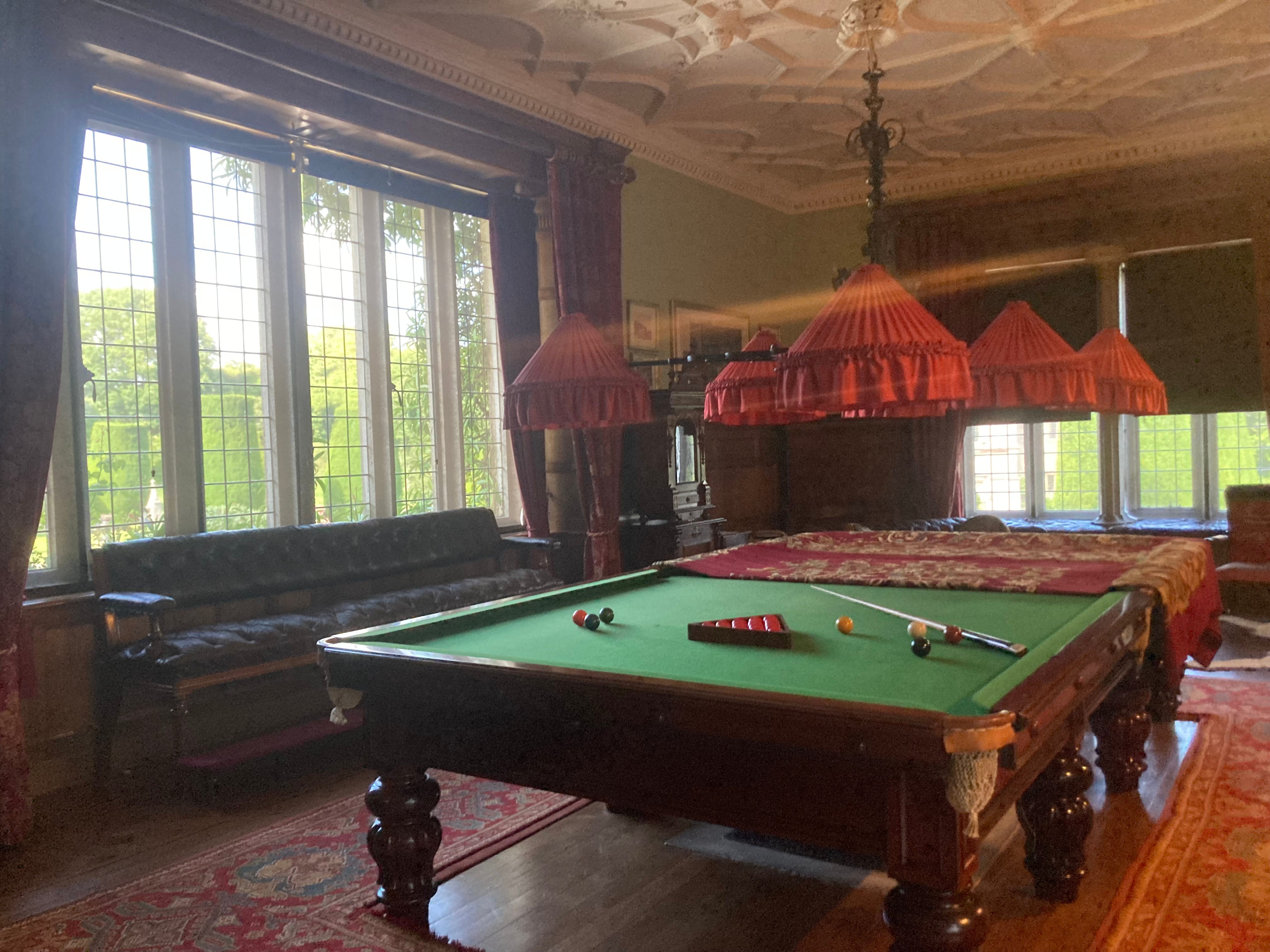
Rooney’s essay is more speculative and philosophical than Knight’s. How does he do it, she asks? How does he play with such virtuosity, such smoothness and ease, judging the angles of rebound and ricochet without any explicit calculation, using only feel? She doesn’t really answer this question, because no one – including O’Sullivan himself – can fully explain it. But snooker, she suggests, does tell us something about the embodied nature of cognition. When you throw a ball at a target, you must ‘run the calculation’ and then ‘make the throw’: but ‘doesn’t it feel’, she asks, ‘as if running the calculation is making the throw?’ The body does not simply carry out the mind’s orders; mind and body, calculation and execution, are integrated. Perhaps the appeal of great athletes is that, through endless hours of practice, they achieve this integration more than the rest of us. At the opposite end of the spectrum, the uncanny fascination of the LLM-powered chatbot is perhaps that it doesn’t achieve this integration at all.
I like Rooney’s essay on O’Sullivan more than her novels, I think, though I think there’s lots to admire about her novels. The rest of this post is about Rooney’s style, not her analysis of snooker. But what I want to dwell on does relate to smoothness and ease.
Rooney has always been able to write a neat figure of speech. Even in the first sentence of Conversations With Friends Frances, in a photo of herself and Bobbi, holds her left wrist in her right hand, ‘as if I was afraid the wrist was going to get away’. Alexandra Schwartz, reviewing that novel in The New Yorker, praised Rooney’s style for avoiding the ‘strobe flashes of figurative language’ by which first-time novelists might be tempted. This doesn’t do justice to Rooney’s talent for figuration. Becca Rothfeld – much less sympathetic than Schwartz to her novels overall – is more accurate, noting the ‘quietly perfect lines’ Rooney sprinkles through her work. All of Rothfeld’s examples are similes and metaphors: a bee casting ‘a comma of shadow’; maggots writhing in a bin ‘like boiling rice’. And the blue summer sky in Normal People, on graduation day: ‘delirious, like flavoured ice’.
Rothfeld also names a quality of Rooney’s novels which both fans and detractors usually agree on: they are ‘compulsively easy to read’. The majority of her sentences are scrupulously free of figuration. They’re normal sentences, composed of everyday words and images. They mostly avoid subordination, structuring thoughts in simple sequence rather than in nested clauses. They wash down very easily: ‘addictive’, as Rothfeld says, ‘in the manner of a Twitter feed’. And then, every few pages, the unobtrusive gleam of one of these accomplished figures. They aren’t ‘strobe flashes’ in the sense Schwartz intends, of attention-grabbing, pyrotechnic showiness. But in a more general sense, Rooney’s deployment of figurative language does have a strobing rhythm: a strict alternation, between little bright knots of simile and metaphor, and a default mode conspicuously devoid of any brightness or knottiness at all.
Sometimes you see this within a single line, as default-mode prose switches to well-judged figure. Back at the graduation ceremony, the full line goes like this: ‘the sky was extremely blue that day, delirious, like flavoured ice’. This is a brilliant simile, not just for the precision of the colour, that slightly synthetic-seeming blue familiar from the churning barrels of Slush Puppie in the corner shop, but also because of the cultural resonances of ‘flavoured ice’, its association with the simple pleasures of childhood, and therefore the poignancy of a sky painted in childlike colours on a day that marks a kind of ritual passing to the adult realm. But the brilliance of the simile is matched, almost exactly, by the utilitarian quality of its lead-in, the total blandness of ‘the sky was extremely blue’. The language is studiously neutral. It describes a heightened state, but ‘extremely’ has been so worn by everyday use that it normalises register even as it intensifies meaning. The blueness is concentrated, but not unusual; the sentence names an extreme version of a normal state, but partakes in the normality not the extremity.
There are two kinds of smoothness here: the quiet, assured skill of ‘delirious, like flavoured ice’; and the utilitarian flatness of ‘the sky was extremely blue’. In her essay on O’Sullivan Rooney confides in us, with a stylish light touch, that she yearns to write novels the way he plays snooker. The virtuosity of O’Sullivan, the smoothness of his cue action and the balls it sends into motion, has much more in common with the intricacy of the simile than the humdrum flatness of its setup.
What’s the problem with the flatness of Rooney’s default prose? Maybe it’s that, after a while, prose which washes down easily ceases to be very enjoyable. A more Puritan way of saying this is that the things which really nourish us require effort to digest. The fact that you can read Rooney’s novels so easily in the moment, with less deliberate focus than most literary fiction demands, maybe also makes them less enduring in the long run.
But I’m suspicious of this kind of argument, because it always seems on the edge of making difficulty a virtue in itself. It also radiates a kind of sniffiness towards the simple pleasure of reading quickly. Anyone who truly loves reading sometimes has read voraciously, regularly as a child and often in adulthood. The problem with the flat style isn’t fundamentally the ease of reading. It’s that the flat style is not very good for representing many aspects of human experience. Here’s Ivan in Intermezzo, sitting on the bus, having just received a message from his mother with an attached picture of his dog, Alexei:
Ivan felt bad about his dog, and missed him, and started to think he really should visit, even all the way out in Skerries, in his mother’s boyfriend’s house, with the photographs of boats on the mantelpiece. He remembered then about the unpaid invoice, about the rent due at the end of the week, the graduate jobs he had seen listed on the website, the opening theory he hadn’t studied, the eulogy he hadn’t given at his father’s funeral, and then, before his thoughts could sink down any more deeply into debilitating dark regret and misery, he thought about Margaret.
This man is ruminating, but the prose shifts too quickly, too smoothly from clause to clause, for the eddying quality of rumination to be felt. His mind is sinking down into ‘dark regret’, but the prose moves too skimmingly to sink with him, to let us feel the brooding of Ivan’s mind, the congealing of his regret to a dark funk. Moving so quickly, with no time to evoke Ivan’s sensations, it is forced instead to name them. It’s unconvincing to me, the idea that we ‘feel bad’ with this degree of self-awareness and temporal particularity, or remember ‘about’ discrete things at discrete times. The ruminating, wandering mind is murkier and more knotted than this, but the flatness of the prose can’t get to grips with the murk. It picks up when Ivan starts thinking about Margaret, because it makes sense for his mind to be racing forward, with a lightness of anticipation commensurate with the quick procession of clauses. He’s excited: ‘time was moving ahead in that direction, towards the weekend, when he could be near her, and he thought about all the things he wanted to ask her about herself’.
The Russian Formalist Viktor Shklovsky thought that literary language was meant to be strange and unusual. That was one of the cornerstones of the theory he is most remembered for in the west, which is defamiliarization: the idea that works of art are there to make the world seem less readily understandable, and in doing so to refresh and renew our ways of seeing. For Shklovsky the strangeness of literary language is an ancient and self-evident notion: he is thinking of the way fairytales and nursery rhymes, often in languages found on the fringes of the Russian Empire like Yakuts and Ukrainian, mark literary language as special with unusual lexical and grammatical forms. Formulating the idea in a 1914 lecture, he asserts that the writers of the previous generation wrote ‘too smoothly, too sweetly’ (sliskom gladko, sliskom sladko). He quotes a remark by the writer Vladimir Korolenko, himself exiled to Siberia: ‘across it the plane of thought runs, touching nothing’. To Shklovsky the two kinds of smoothness – the virtuosic feat of figuration, and the flat monotony of the default – are one. Both make thought into a plane (rybanok) which cannot get any purchase on the world.
What is required, says Shklovsky, is a ‘tight’ language, a language which arrests that plane, gives it something to snag on, sink its teeth into. ‘Tightness’ in English, when used for prose, has come to denote something else – the kind of concise, workmanlike neatness often valued in journalism and associated in literature, a little mistakenly, with Hemingway and his mob. The Russian word, tygoi, has roots in an older verb that connotes ‘pull’, or ‘pulling back’. By ‘tight’ Shklovsky means language that doesn’t yield easily to the plane of thought, that mounts resistance, compelling the mind to slow down and engage with a new kind of attention. So perhaps a better English word would be ‘chewiness’.
The problem with lots of contemporary novels is that their prose is insufficiently chewy. Across their pages the plane of thought runs, touching nothing. Similes and metaphors, which occupy such a central position in our idea of what constitutes the literary, are not enough. Prose needs more than occasional dashes of figuration to achieve chewiness; defamiliarizing strangeness needs to be spread across the page, rather than winking up every few paragraphs with the occasionality and superfluousness of ornament.
Writers of contemporary fiction who are good at chewiness include Karen Russell and Rónán Hession. In Russell’s short stories and Hession’s novels words are used in slightly unusual ways: a verb deployed in the original sense from which, in everyday speech, it has slipped; a word order that hovers between ‘obviously quotidian’ and ‘obviously fairytale’. I don’t think it’s a coincidence that both writers specialise in creating states of near-familiarity, fictional worlds which are neither obvious reproductions of the supposed ‘real world’, or obvious fantasies. Chewiness is created in part, I think, even on the auditory level of the sentence, by making sure there aren’t too many small words, or even words without consonant clusters, over which the reader’s ear starts to skate, processing them on autopilot. But it might also be that chewiness is created by the same quality which, for the writer Matthew Specktor, defines literary style: the ability to operate ‘in more than one register’; to weave multiple tones together, creating productive tensions of serious and jokey, high and low, conversational and poetic.
The plane of thought might enjoy its uninterrupted glide, but without chewiness it will eventually glide off prose altogether. And then it will pick up its phone, sleekly waiting nearby, and have an easy, unchewy glide on that. Scrolling is perhaps the least frictional, least chewy activity the plane of thought has ever been offered, and the absence of any difficulty in it, any kind of neurosis or jeopardy, is what makes its pleasures – its weird combination of familiarity and novelty, the dopamine hit of variable but self-repeating rewards, at once random and rectilinear – ultimately much less satisfying than watching snooker. The internet, as currently configured, has made language supremely unchewy. Joe Moran notices that his students, saturated in online discourse, have come to think of language in a way that is weirdly close to ancient Judaeo-Christian dreams of angelic communication, in which the distance between words and their referents had closed utterly, so that words become shiningly transparent, ‘an empty vessel through which meaning pours, clear and cold as water’.
Instinctively I am less of a smoothness-hawk, I think, than Shklovsky. I think the smoothness of virtuosity – of an O’Sullivan topspin positional shot, or ‘delirious, like flavoured ice’ – is to be sharply distinguished from the smooth flatness of utilitarian, cuts-through-like-butter prose. But I also think we are drowning in smoothness of the second kind, in weightless words. Falling for the fantasy of angel language is a terrible fate: it deconditions the mind from cultivating the ability to grasp onto the world. Surrounded by thin language, we need a literature that defamiliarizes, that teaches us to snag again on the knotted textures of the outer and inner life. We need chewiness.