
Being Jim Ratcliffovich
Companies, clubs, countries

A British chemicals tycoon sat down with Sky News to discuss the state of the country he lives in, some of the time. Britain is beset with problems, Sir Jim Ratcliffe told Sky News’s Ed Conway at the European Industry Summit in Antwerp. The economy’s on its knees, bogged down by excessive claims on an inflated welfare state. The Prime Minister’s toothless and unwilling to take difficult decisions. Most of all, the country’s been swamped by immigrants – except Ratcliffe chose a word even meaner and nastier than ‘swamped’: the UK, he said, has been ‘colonised’.
Since early 2024 Jim has owned a minority but controlling stake in Manchester United. He tried to buy Chelsea when it was stripped from Roman Abramovich in 2022 as a Russian asset, but that didn’t work out, so he remembered his undying loyalty to Manchester United and bought them instead. It was the latest addition to an already impressive sports portfolio. INEOS, which returned to the UK from Switzerland in 2015, but which remains registered in Monaco for tax-avoiding purposes, sponsors prominent cycling and sailing teams. At Man Utd the sailing hasn’t been especially plain; Ratcliffe has chopped and changed managers without good effect, made hundreds of staff redundant, and failed in the transfer market. In fact, Jim told Ed, the country’s predicament reminded him of the problems he’d faced running his new club.
Ratcliffe’s comments were roundly and rightly condemned. ‘Colonised’ is an ugly smear based on an absurd lie: that the sizeable constituency of people currently claiming benefits in the UK, ‘rather than working for a living’, is composed completely of immigrants. Ratcliffe deserves all the opprobrium he’s received – from Man Utd supporters’ groups, progressive commentators, and the government – and he should be ashamed of his chickenshit non-apology, a mealy-mouthed dogwhistle about offending ‘some’ people with his choice of words.
There’s an exasperated, dry, centre-left argument out there which despairs of immigration always being framed in the UK as a cultural issue, a contest between the left’s empathetic cosmopolitanism and the right’s patriotic rootedness. Contrary to this ‘cultural framing’, the self-appointed grownups like to say, immigration is really about economics: it’s about cheap labour and globalisation, and it always has been.
I’m sympathetic to this argument, but I think ‘colonised’ implies something stranger than that flawed ‘cultural framing’. We had no say, Jim is telling us, about all these people entering our country. Not just the common people, but the government too: everyone was completely powerless. By the logic of ‘colonised’, the government was like a pre-contact native leadership, its will overrun by the colonising immigrants.
In reality, a series of decisions were made by a series of elected governments. After the dissolution of the empire, in search of cheap labour, postwar governments promoted immigration from Commonwealth countries. Britain joined the EU, which in the 90s enshrined free movement of people. Then the British electorate directed its government to leave the EU, but Britain retained legal obligations to asylum seekers encoded in international law.
In Jim’s ‘colonised’, however, all these decisions are conflated into a single amorphous passivity, and this aggrieved passivity was at the heart of the Brexit animus. Free movement within the EU – the rights of white, Christian Poles and Lithuanians and Romanians to live and work here without our express permission – functioned less as a bête noire, a problem in itself, than a hazy metaphor for how people felt about kinds of immigrants perceived, in their ethnic and cultural otherness, as more alien. Jim, needless to say, was a big Brexiteer.
The FA decided not to charge Ratcliffe, and just ‘remind him of his responsibilities’. As the righteous fury abates, it’s the comments surrounding ‘colonised’ which are maybe more interesting, because they shed light on the assumptions underpinning a sector of British political sentiment, a sector underrepresented online and in the apocalyptic warnings of the progressive media: entrepreneurial, Eurosceptic, pro-market and anti-state, hawkish on regulation but at the same time stoutly in favour of the rule of law. The kind of Tories who are keener by miles on Thatcher than Trump, and who prospered in the Tory party until its toxification by Liz Truss, a person so talentless and deluded that she’s not even very good at being a Trump bootlicker, which is all she’s good for.
Ratcliffe turned down the opportunity to lay into the Prime Minister, Keir Starmer. ‘I know Keir’, he said, ‘and I like him’. But Starmer’s problem was that he was ‘too nice’, unwilling to make unpopular decisions. Jim, on the other hand, is willing to soak up some unpopularity. For inspiration on how to run the country, Keir should look to Jim’s running of Man Utd: he cut hundreds of staff and acted parsimoniously in the transfer window. It was glossed over that Starmer’s ministry is deeply and persistently unpopular. If Jim’s right, and Starmer’s ‘too nice’, then it’s an absurd loop: Starmer is unpopular because of his reluctance to be unpopular.
What’s extraordinary about this interpretation is the assumption it rests on, so deep it’s acquired the character of a self-evident truth: the idea that running a company is like running a government of a nation state, that the attributes and behaviours which bring success in the former are straightforwardly transposable to the latter. This assumption is so fundamental to contemporary right-wing thought that it could even be described as the principle unifying an increasingly incoherent coalition of ideologies and approaches. Even the fanatics taking over America, who challenge every other conservative orthodoxy, cleave to this axiom of simple transposition from the private sector to the realm of politics and government. It’s the rationale underlying Musk’s DOGE rampage and Curtis Yarvin’s fantasies of a CEO monarch. It’s Trump’s logic in appointing Steve Witkoff, a New York property developer, to handle the American state’s negotiations with the Russian government.
This is not to deny that the contemporary British state could do with a shake-up, be made more agile and efficient. There is a grain of truth in what Ratcliffe says about the economy, despite the poisonous illiteracy of his scapegoating of immigrants. The welfare state isn’t functioning as it should, delivering neither justice nor efficiency: too many people are sick; work isn’t working for great swathes of the population. We don’t need a tougher, more brutal economy, but we do need one that stimulates and distributes prosperity. Getting the economy back on track will require political courage and – in a rapidly constraining geopolitical climate – difficult decisions.
But even a super-efficient British state would function in a manner wildly different from a corporation. An CEO unpopular with the public can shrug at their unpopularity. An unpopular Prime Minister has to worry about their unpopularity, because it brings trouble in Parliament, and ends in defeat at the ballot box. CEOs are answerable, ultimately, to profit margins and shareholder value. Governments in democratic states, by contrast, have to navigate enduring conflicts of interest: party and country, the voter base and the wider population; political capital and good government.
The English political scientist Jim Bulpitt called this ‘statecraft’: ‘the art of winning elections and achieving some necessary degree of governing competence in office’, where that ‘and’ is understood as a balancing act. No one in their right mind could say that Keir Starmer’s government exemplifies skilful statecraft. But the fact that Jim Ratcliffe diagnoses the Starmer ministry’s core problem as being ‘too nice’ indicates that the concept of statecraft itself is utterly foreign to him and his way of thinking. Politics disappears: it’s to be understood only as a subset of economics. And economics itself is really just a set of natural virtues and intuitive truths: working hard, trimming the fat, scoffing at abstraction and expertise.
Ratcliffe’s tenure at Man Utd should already have taught him that these supposedly self-evident principles don’t transpose easily from the corporate world even to a football club. Manchester United is a corporate entity with something non-corporate at its centre: a team of equals, which in order to flourish requires not just agility and ambition but also strict regulation. Successful football teams need to be unpredictable; they need creativity, flair and adaptivity. But those kinds of unpredictability rest on a solid defensive base, and the success of the whole footballing aspect of the operation relies on settled patterns of routine and regularity off the pitch. The fans are not ordinary customers, because they come back regardless of the quality of the product, and rarely switch to a rival product. If business logic doesn’t apply uncomplicatedly to a football club, it sure as hell won’t apply uncomplicatedly to the government of a democratic society.
There are many businesses, of course, of which this is equally true – businesses built on solid bases, which thrive as much from regularity as from agility and disruption. But they are not businesses of the kind which Ratcliffe owns.
The most amazing of Ratcliffe’s comments in his interview with Ed Conway comes when he backs up his claims with statistics. It’s colonisation, Jim implies, because it’s happened so quickly. ‘The population of the UK was 58 million in 2020’, said Ratcliffe, and ‘now it’s 70 million. That’s 12 million people’.
The population of the UK in 2020 was just above 67 million. Ratcliffe, speaking in the no-nonsense tone of a man of the world who tells it bluntly like it is, gets it spectacularly, appallingly wrong, off by nine million. Could it be that he made a mistake endemic to political discourse in these islands, and got confused between England (just under 58 million people in 2020) and the United Kingdom of which England’s the largest part? Who knows. In any case, what’s more telling than Ratcliffe’s error is the confidence underpinning it. Who in Jim’s world, after all, was going to challenge Ratcliffe in his commonsense, no-nonsense belief that nine million people had immigrated to Britain in half a decade? Not constraints on his power, or public scrutiny, or scepticism in his colleagues, because he doesn’t need to burden himself with all such red-tape bureaucratic tedium. And not empirical experience either. When does Jim Ratcliffe encounter the country he is pontificating about? From the padded seat of the private jet that whisks him across the channel? From the tinted window of the chauffeur-driven car that ferries him to and from the director’s box at Old Trafford? How would he know? He doesn’t spend enough time in Britain to pay personal tax here.
Something more than politics disappears, in the oligarchic worldview of figures like Ratcliffe: society itself goes missing. Society gets hollowed out, conceptually privatised, appearing not as a variegated, complex structure of people, but instead as just a set of symbols and ossified traditions imagined as permanently besieged. British people appear only once in Ratcliffe’s comments, when he mentions the childish refusal of Man Utd fans to understand that if you buy a player now you’ll have to pay for him later. To Ratcliffe the British public are the Roman plebs: clamouring and irrational, unwilling to live within their means. Not a society of rational agents, a complex relation of parts, but a single amorphous crowd to be fobbed off.
It might be that by the end of this decade people like Ratcliffe have even more power in this country than they already do. I don’t think the risks are the same as the risks of Trump and his goons, because I think the British right is still much closer to the Thatcherite consensus than the American right is to Reaganism. The danger of the Jim Ratcliffes is something fairly insidious: it’s the big hole in the centre of their knowledge, the hole where society should be. Krishan Kumar, pioneering sociologist of Englishness, argued that there is something particularly English about this hole, reflected in an English reluctance to do sociology, a snobbish recoiling from the idea that we are, like Europeans, an ordinary society which can be studied, mapped, and maybe even listened to. Ratcliffe can’t even listen to the fans of his own football club.
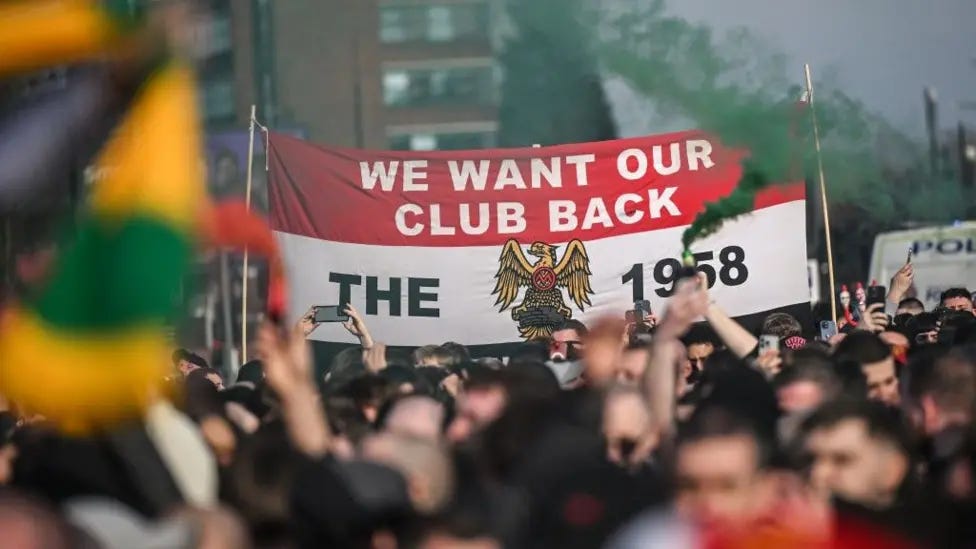
We, on the other hand, can listen to football fans. We can listen to the words of the Man Utd supporters’ group The 1958 – not a hysterical mass of childish proles, but an informed and democratic social organisation, who reacted to Ratcliffe’s bloviating interview by calling him what he is: ‘an incompetent clown’. A man who doesn’t live in Britain, and doesn’t understand its politics, lecturing us all on how Britain should be run when he can’t even f---king count. Milton, thou shouldst be living at this hour, &c.
Excellent. Thank you.